Soup and Bread – One of Those Perfect Combinations

I love soup and once the weather turns I could eat it everyday, unfortunately Stella does not like soup.  I was hoping that this soup would be the one since it had sweet potato and butternut squash in it – but no luck.  I am going to keep trying until we find a soup she likes – if anyone has any recipe suggestions – PLEASE pass on.  To me, bread is the perfect combination with soup – can nibble on it along with the soup or my favorite, dipping the bread into the soup – yum!  So, with my helpers, dinner rolls were made.

We had one of the neighborhood kids with us last night – he came to keep us company since his parents needed to work, but we were fortunate that his mom finished up her appointment early and was able to join us for dinner!

The soup recipe is from a cookbook, not sure which one since I was given a copy, but it does call for a red bell pepper – which I omitted.  If I cook anything with pepper – I cannot taste any of the other flavors – just pepper – so I do not use.  I will put the step in for those who want to add – the soup was delicious without it.

Squash and Cannellini Bean Soup

Ingredients

1 red bell pepper, halved and seeded
4 cups vegetable stock
1 onion, finely chopped
2 garlic cloves, crushed
1 butternut squash, peeled, seeded and diced
1 lb sweet potatoes, peeled and diced
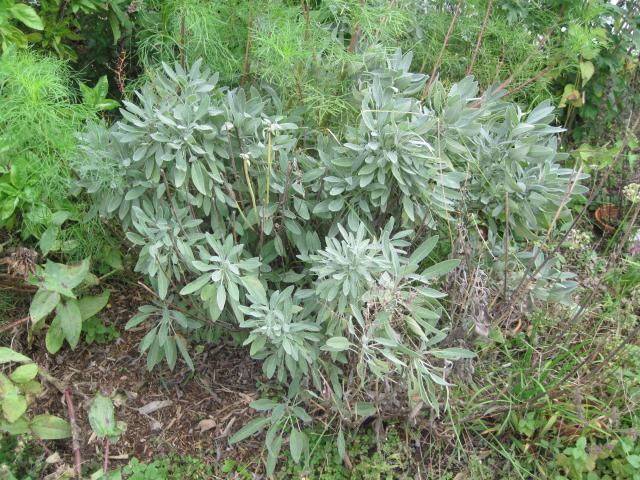
1 tsp chopped sage (I got it right out of my herb garden!)
1 bay leaf
1 1/2 cups canned cannellini beans, drained and rinsed
1 tsp olive oil
juice of 1/2 lemon
black pepper


1. Place the bell pepper skin side upward under a very hot broiler until blackened.  Place in a plastic bag and leave to cool slightly, then remove the skin and cut into very thin strips.
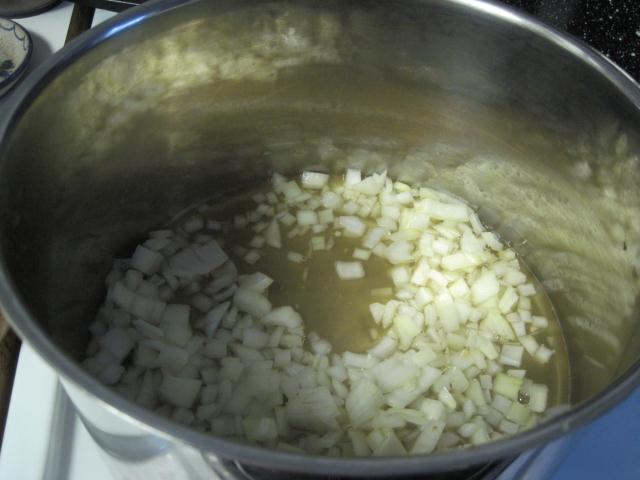
2. Heat a little of the stock in a large pot and gently saute the onion and garlic until softened.
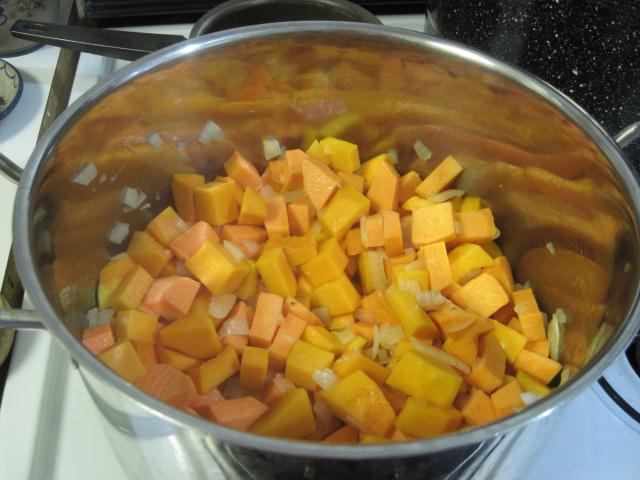
3. Add the squash and sweet potatoes and cook for 5 minutes.
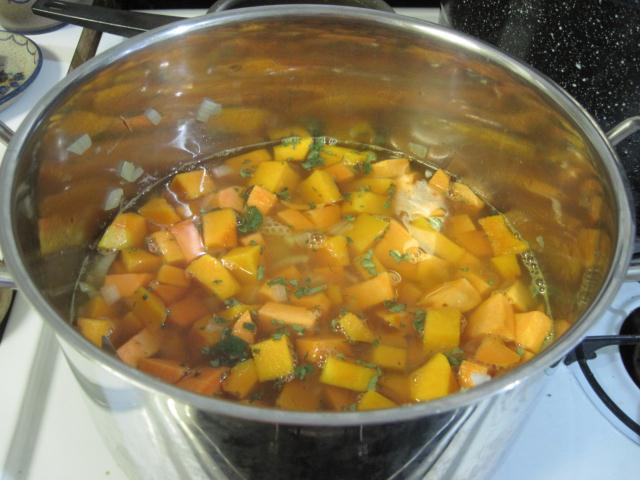
4. Add the red bell pepper, rest of the stock and the herbs – bring to a boil.  Reduce the heat, cover and simmer for 30 minutes or until the vegetables are tender.

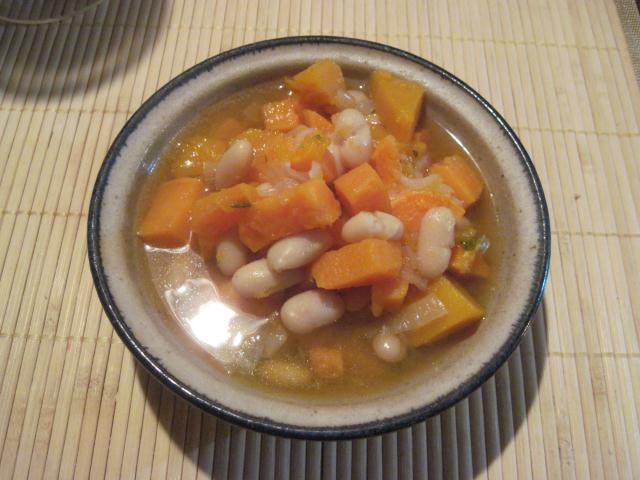
5. Remove the bay leaf.  Add the beans, olive oil and lemon juice and season with black pepper.  Cook for a further 5 minutes, then serve.
Dinner Rolls

Ingredients

1 package quick acting dry yeast
1 1/3 cup milk (heated to 105 – 115 degrees)
3 – 3 1/2 cups flour (I used 2 cups whole wheat flour and the rest unbleached flour)
3 Tbl olive oil
1 Tbl sugar
1 tsp salt
1 Tbl butter, melted
course salt

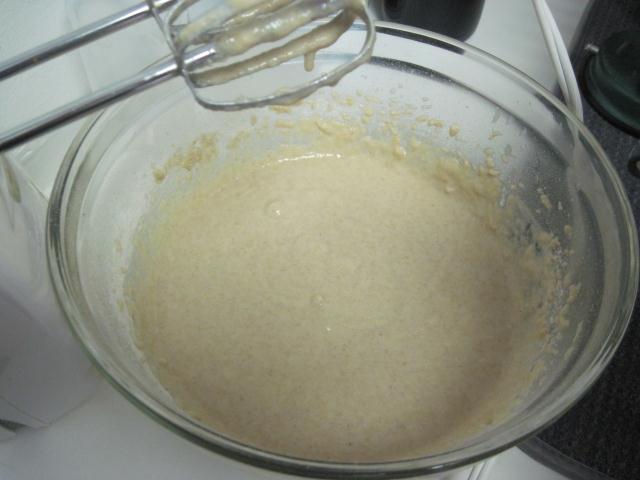
1. Disslove yeast in  warm milk with sugar in an electric mixer bowl.

2. Stir in 1 cup flour, oil and salt, beat until smooth.
3. Stir in enough remaining flour, scraping dough from the sides, until a soft dough forms.
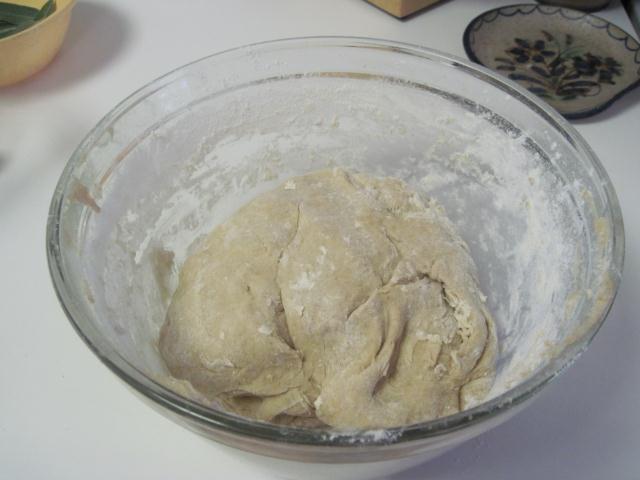
4. Cover and let rise in a warm place until double in size, about 45 minutes.

5. Spray a 12 cup muffing pan with non-stick spray (I used my misto filled with olive oil).

6. Preheat oven to 400 degrees.

7. Punch down dough in cneter and fold over a few times.
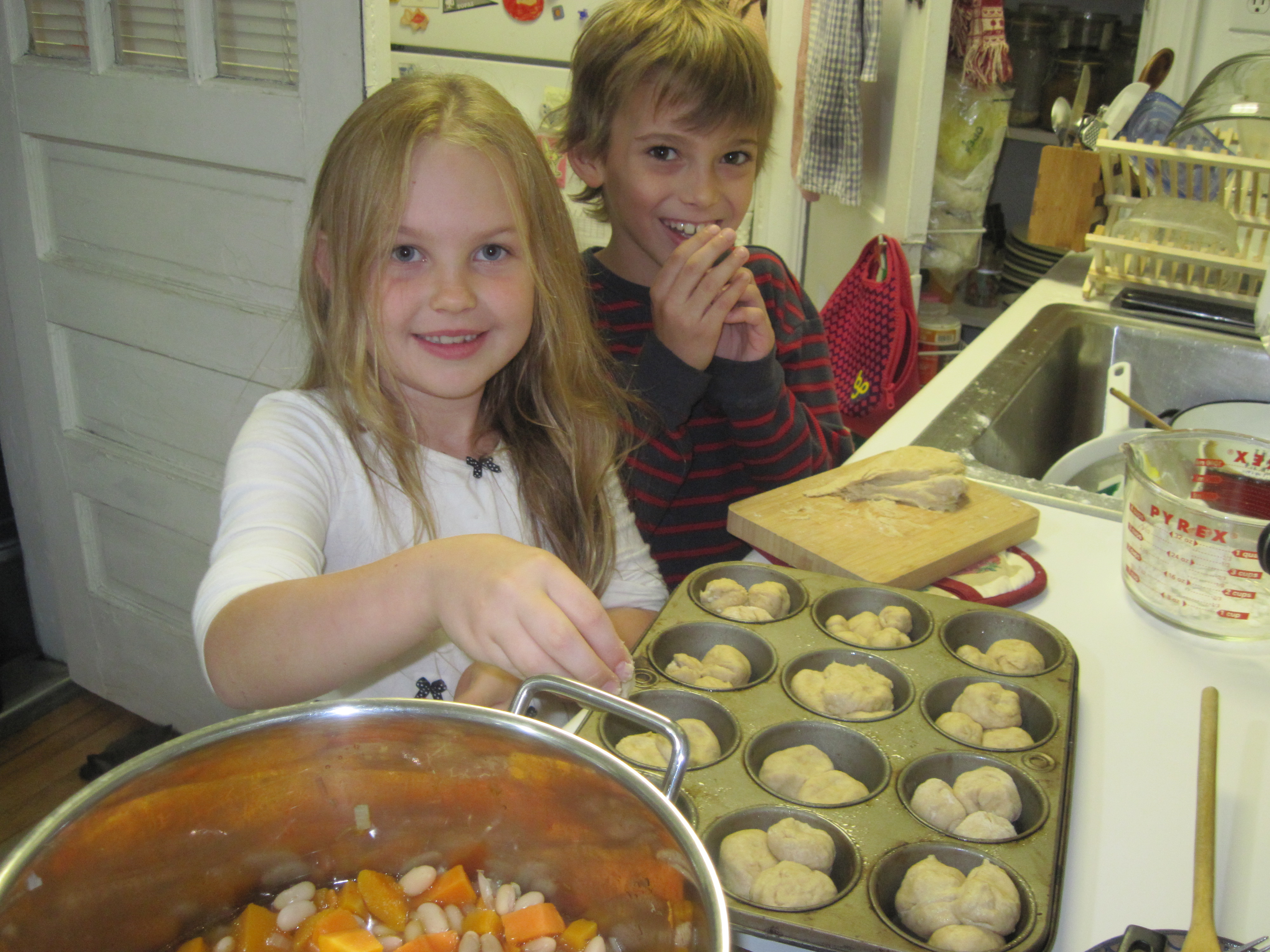
8. Pinch off 1 inch balls of dough and quickly roll in palm of hands.  Put 3 balls to one muffin cup.  Fill all 12 cups.

9. Brush melted butter on all and srpinkle with course salt (I omitted).

10. Bake 12 – 15 minutes or until crust is light golden brown.  Immediately remove from pan, place in bowl and cover to keep warm.
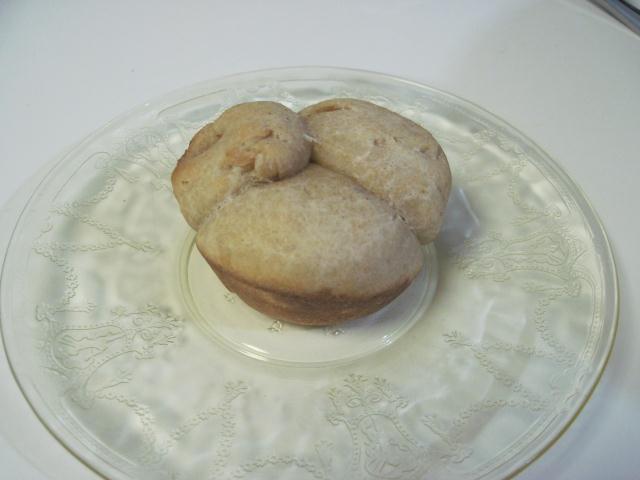
I used a yeast specific for whole wheat flour – the rolls were very dense – not sure why – I had never used this yeast before.  My helpers rolled the dough longer than I would have, but they were having fun and loved helping.  Even though they were denser than expected – they went fast and were enjoyed by all.


Digiprove sealCopyright secured by Digiprove © 2011
Posted in Recipes | Tagged , , , | 4 Comments

Get A Head Start on Gift Making

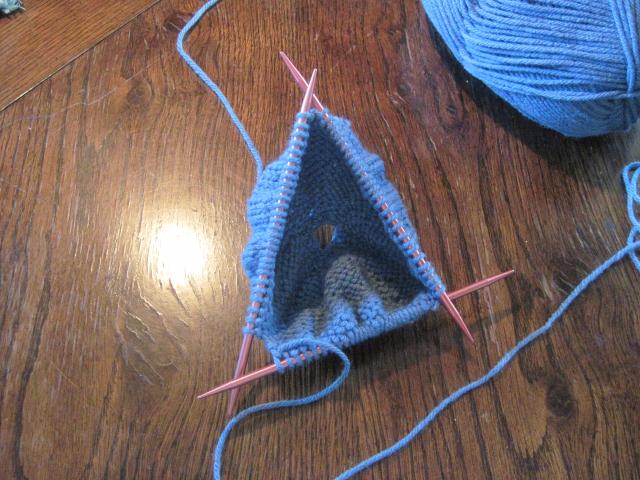
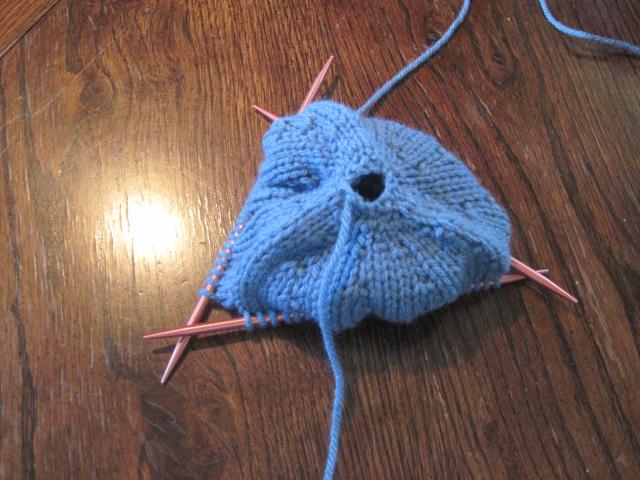
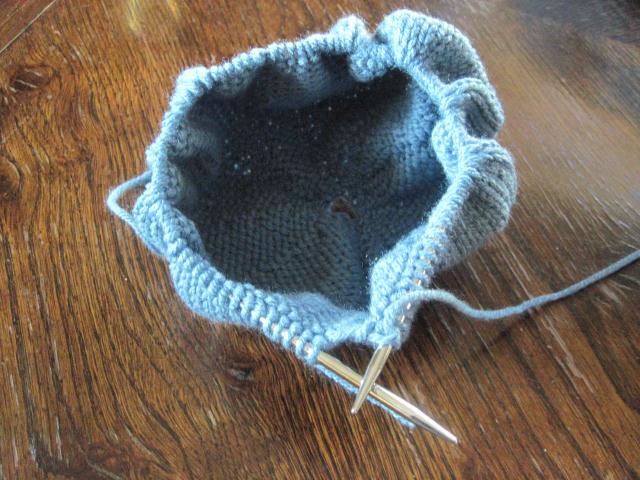
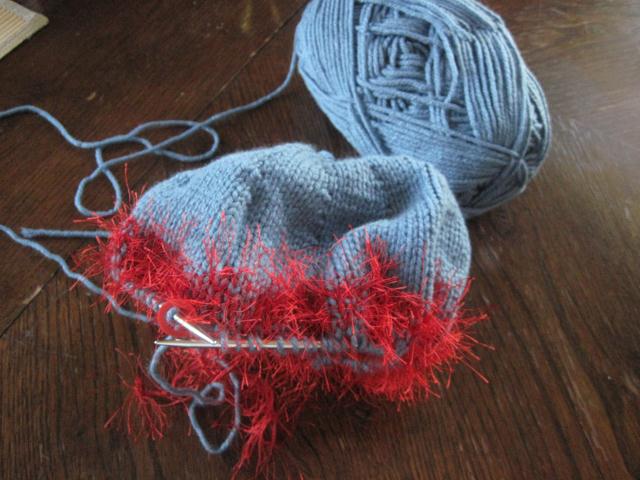
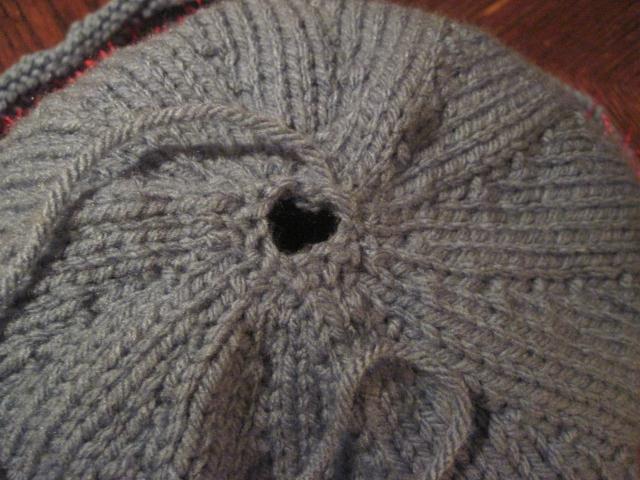
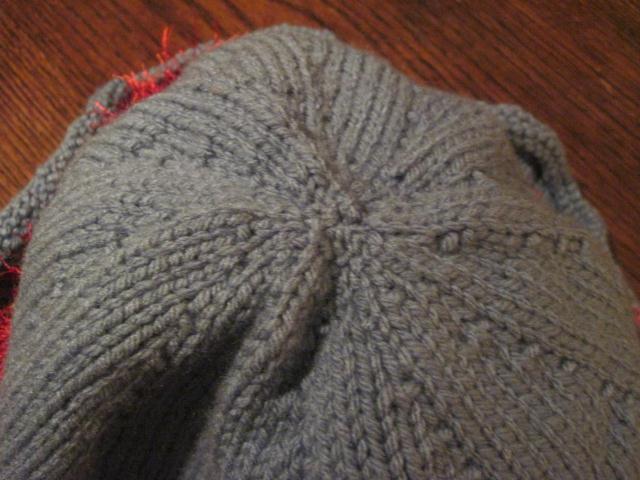
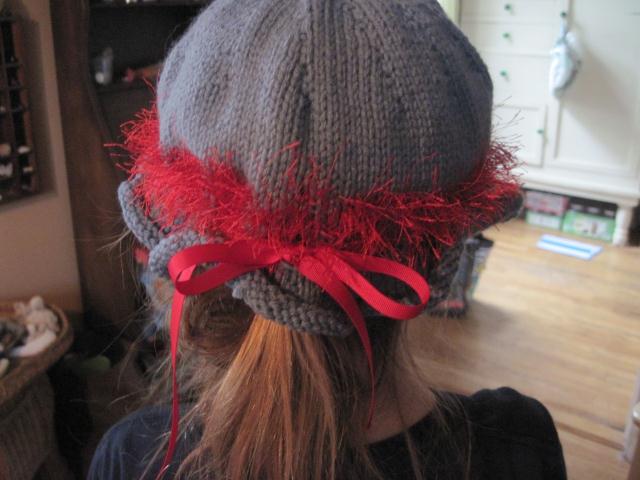
I have started the Christmas gifts in earnest and have completed several fingerless mittens and water bottle carriers.  This week I started and finished a  child’s hat.  The one nice thing about this hat, and I am not really sure if this was part of the design, but because you can weave in ribbon – if size is not quiet right you can pull the ribbon and tighten – which I had to do.

I found this pattern on ravelry.com but it is really from http://www.bluemountainhandcrafts.com/free-patterns.html – check out their whole site, the patterns are great, but their yarns are fabulous!

Wavy Edged Hat Pattern

You will need:
* size 7 in DPN’s and circular needles–you will start on DPN’s and then have to
switch to a circular as your stitches increase and you find them becoming
unmanageable on DPN’s
* 1 stitch marker
* 1 row counter
* optional grosgrain ribbon approx. 6″ longer than the circumference of the hat
size to be made
* 4 oz. worsted weight yarn
* crochet hook size G or I used a darning needle
Gauge: 6 stitches per 1″ 7 rows per 1″
Stitches:
I–increase, knit 1 in front and in back of same stitch before slipping off left hand
needle
titches continued:
K4tog–knit 4 stitches together
K3 in 1–in same stitch: knit 1 in front, knit 1 in back, and knit 1 in front before
sliding off left hand needle.

Sizes:
0-6 months 12″ circumference
6-12 months 14″
1-2 years 16″
2-4 years 18″
4 and up 21″
To Begin:
Cast on 12 stitches evenly over 3 DPN’s
Round 1: Knit
Round 2: K1, I, K1, I across each needle (18 stitches)
Round 3: K1, I, K1, I, K1, I across each needle (27 stitches)
Round 4 & 5: Knit
Round 6: K2, I, K2, I, K2, I across each needle (36 stitches)
Round 7: K2, I, K2, I, K2, I, K2, I across each needle (48 stitches)
***Add 4th needle–12 stitches on each needle (I did not add the 4th needle)
Round 8-10: Knit
Round 11: K3, I, K3, I, K3, I across each needle (60 stitches)
Round 12- 13: Knit
**for 12″ 0-6 months hat jump to Round 27
Round 14: K4, I, K4, I, K4, I across each needle (72 stitches)
Round 15-17: Knit
** for 14″ 6-12 months hat jump to Round 27
Round 18: K5, I, K5, I, K5, I across each needle (84 stitches)
Round 19-20: Knit
** for 16″ 1-2 years hat jump to Round 27
Round 21: K6, I, K6, I, K6, I across each needle (96 stitches)
Round 22-23: Knit
**for 18″ 2-4 years hat jump to Round 27
Round 24: K7, I, K7, I, K7, I across each needle (108 stitches)
Round 25-26: Knit
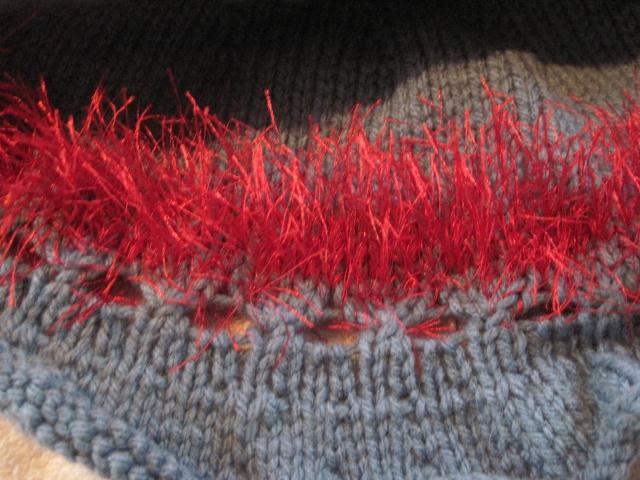
Round 27-40: Knit ( I added the fun fir rows 32 – 38)
Round 41: Yo, K4tog repeat to end of round (make sure you get all 4 on the needle – I didn’t one time and had to retrace steps!)
Round 42: K3 in 1 (K1, P1, K1 in same stitch), K1 repeat to end of round
Round 43-45: Knit
Round 46: K1, I repeat to end of round
Round 47-49: Knit
Round 50: K3, I repeat to end of round
Round 51-53: Knit
Bind off and weave in loose ends.
With crochet hook or darning needle weave tail of yarn from cast on through beginning 12 stitches(I usually go through the stitches twice) and pull closed). Thread tail to inside of hat and weave in loose end.


Weave ribbon through eyelet holes and tie in back.

I think I need to find myself a new model!  Every time I have Stella try something on it is inevitable that she then asks me to make her the same thing – but it does give me ideas for her birthday which is coming up.  I am pretty busy at night making her gifts and then hiding them so she does not see or ask who is that for.


Digiprove sealCopyright secured by Digiprove © 2011
Posted in Crafts | Tagged | 1 Comment

Rice Pudding Made With Brown Rice

I love rice pudding, but I have never been successful in making it – usually the rice is hard.  While looking for a new weekly recipe I came upon a recipe for Brown Rice Pudding and, well, being one of my favorite desserts – I just had to make it.

It calls for 2 1/2 cups cooked brown rice – so I took the rice cooker out and started measuring 2 1/2 cups of rice and then I caught myself – I need 2 1/2 cups cook not 2 1/2 uncooked rice.  I buy my rice in bulk and store in a glass container – so I could not look at the back of a bag – what was the ratio of uncooked rice to cooked rice – I had no idea, so I went to my neighbor to see if she had a bag – but she stores in glass too – so no bag – neither one of us could figure it out – I guess I could have gone to the internet, but I figured why not experiment and if there is leftover then I have rice already cooked for the week.

OK – so yes, I was having a blond moment with the rice ratio!!!  As soon as I measured and put into the rice cooker, the light bulb came on and I realized it is double the uncooked rice amount, duh!

Brown Rice Pudding with Golden Raisins and Toasted Almonds ( Fresh from the Vegetarian Slow Cooker cookbook)

Ingredients

2 1/2 cups cooked brown rice
1 1/2 cups milk or vanilla soy milk (I used the soy milk)
1/ cup firmly packed light brown sugar or a natural sweetener (I used brown sugar)
1 tsp vanilla extract
1/2 tsp cinnamon
Pinch of salt
1/3 cup golden raisins or other dried fruit
1/2 cup sliced almonds, toasted

1. Make 2 1/2 cups brown rice, unless you already  have some in the fridge.

2. Combine all the ingredients, except the raisins and almonds in a lightly oiled 3 1/2 – 4 quart slow cooker, stir to mix well.

3. Cover and cook on Low for 3 – 4 hours, stirring once about halfway through – add the raisins at this time.

4. Serve warm or cold, garnish with toasted almonds (I omitted – not a huge fan of almonds in my rice pudding).

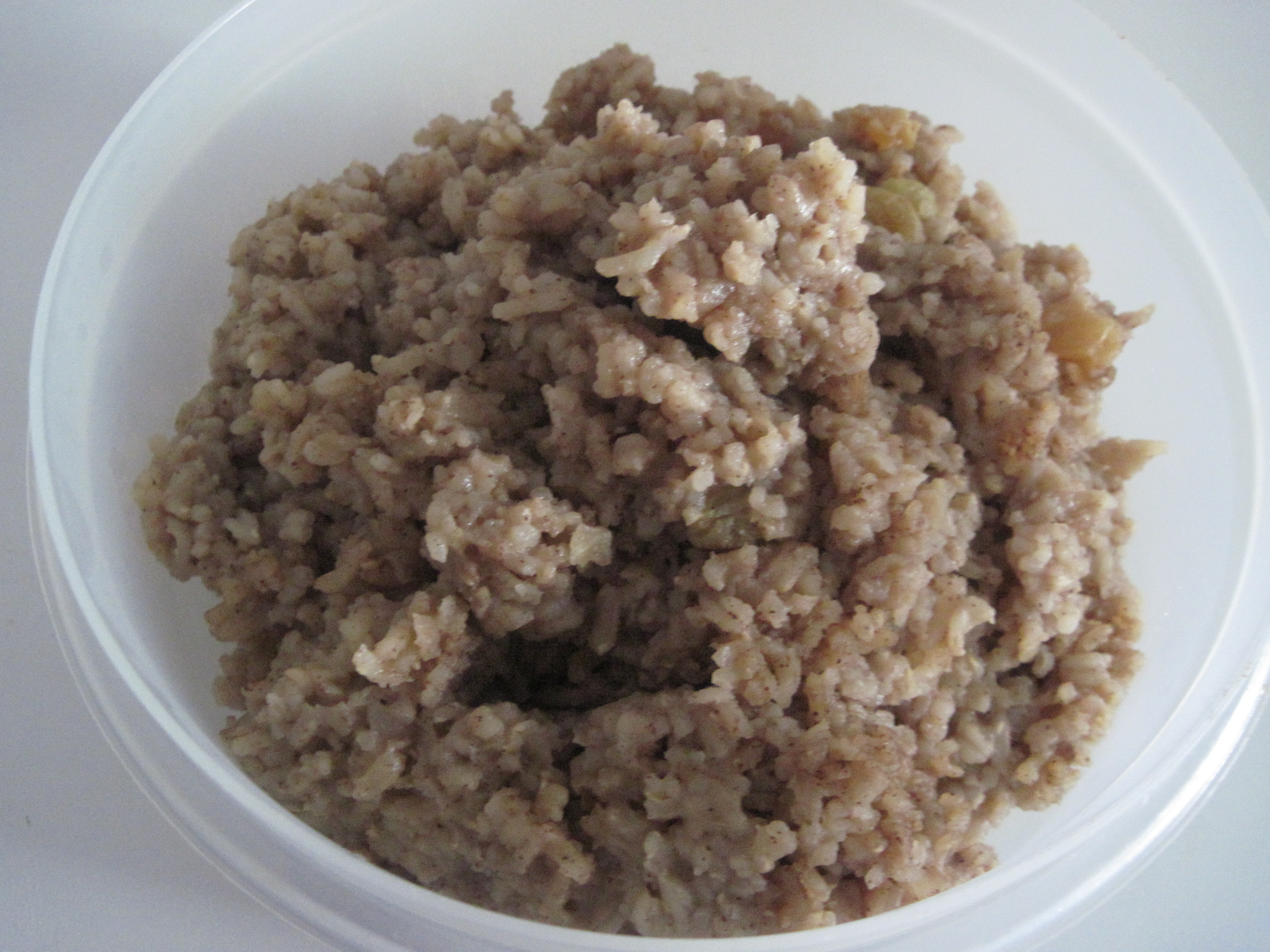
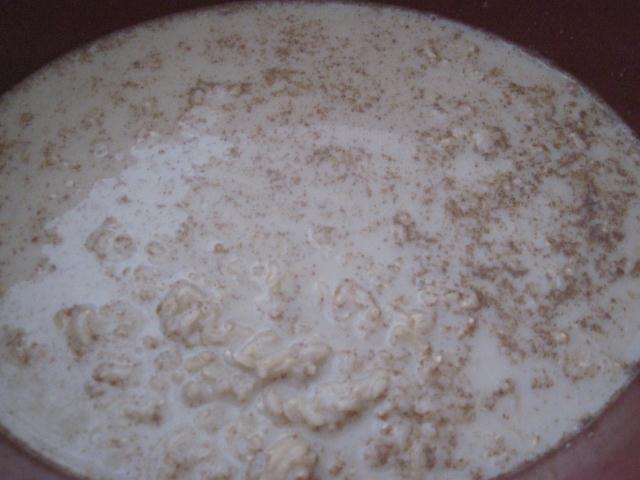
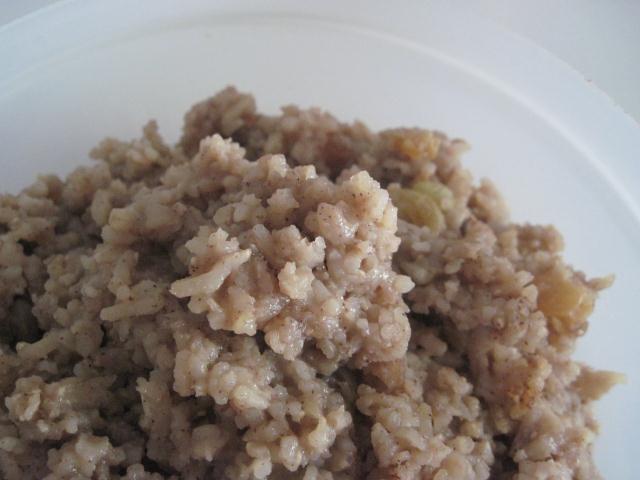
As you can see from the picture – this is not the rice pudding you buy in the store – it is not pudding with rice in it.  Looking at the outcome, I was a little disappointed, thinking this is not rice pudding – but once I tasted it – fabulous!  It is hearty, sweet and a really nice texture.  Stella who does not like rice, wants this for every meal.  I will definitely make this again, but think I will try some dried apricots or apples in it.

Digiprove sealCopyright secured by Digiprove © 2011
Posted in Recipes | Tagged , | Leave a comment

When’s The Last Time You Cleaned Your Pillows?

I was doing some reading and was shocked when I read an article stating that you should clean your pillows every 6 months.  I clean my pillows, but that usually meant letting them sit out in the sun for a day to air out.  I figured every 6 months would coincide with a thorough spring and fall cleaning.  This is usually when I take all the curtains down and wash, clean the shower curtain and liner, the windows inside and out and don’t forget the screens.

This past weekend I decided I would do all the bedding, it also helped that the weather changed and we had 2 days of the sun shining and the temperature in the 80’s.  I took all the sheets washed them and then hung them on the line to dry.  I then took the feather beds and put them out to air out and get some some sun – I sprayed them down with a mixture of vinegar, water and lavender essential oil.  My washing machine is not big enough to wash them and I will be going to the laundry mat to clean them within the next couple of weeks.

I then sprinkled baking soda on the mattresses, putting the baking soda into a shaker, giving a coating to the whole mattress and let sit for the day.  Before putting the sheets back on I vacuumed the mattresses making sure to get all the baking soda up – the mattresses smelled fresh after doing this.  I think next time I will add some lavender oil to the baking soda – lavender is suppose to help relax and induce sleep – so why not and I love the smell.

I then did the pillows and with 6 pillows this was an all day project.  I went to the local sporting goods store the day before and purchased a can of tennis balls.  Several of my pillows are down and if I followed the manufacturers directions for cleaning I would have brought them to the dry cleaner – I did not want to clean my pillows with chemicals.  We have a dry cleaner here that says it is organic, but they purchase the chemicals to clean with from Chevron and BP – to me that is not organic.  Following the directions below you will be amazed with the results and your pillows will be as full and fluffy as when you first purchased them!  I have to preface that this is not too eco-friendly, but it is better than the dry cleaners.

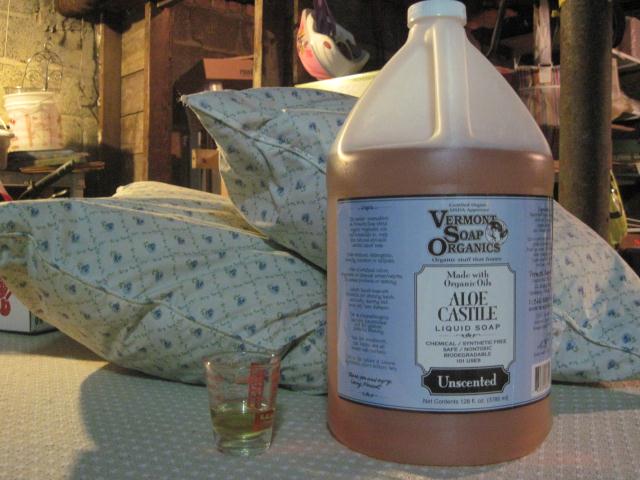
1. Washing 2 pillows at a time, fill the washing machine to about 2/3 of the way full and put in some liquid soap, not detergent – making sure it is dissolved before putting the pillows in.

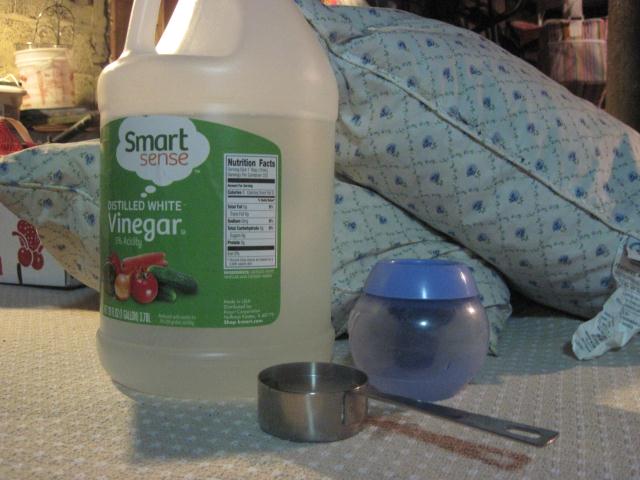
2. Using a fabric softener ball I filled with 1/4 vinegar.  Using the vinegar in the final rinse cycle will make sure that all of the soap is out of the pillows and will help kill germs.

3. Let the wash go for the full cycle and then do an extra spin cycle, making sure to get as much water out as possible – this will also help with the drying.

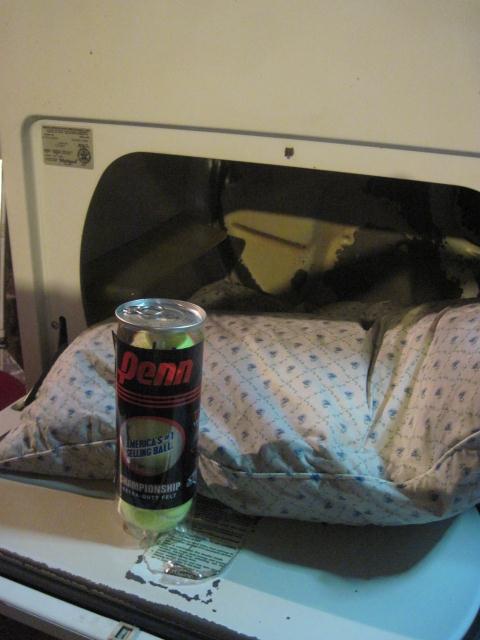
4. Place the pillows in the dryer with 3 new tennis balls.  The tennis balls will help un-clump the feathers and make the pillows so fluffy.  Make sure the heat is on low.  I had to do the pillows on two dry cycles to get completely dry – you do not want the pillows to be at all damp.

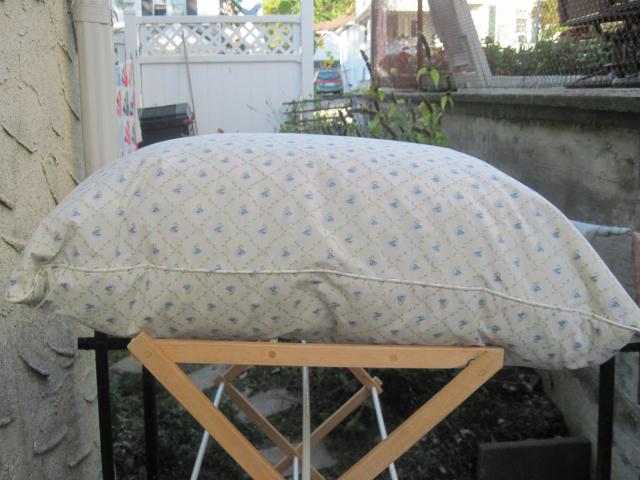
5. Look how fluffy the pillow is!  They won’t be as easy to get into the pillow case as they used to be.  All the dried sloughed off skin, bacteria, dust mites and dirt and gone – sweet dreams!

Digiprove sealCopyright secured by Digiprove © 2011
Posted in Life | Tagged , | 2 Comments

More Felted Soap

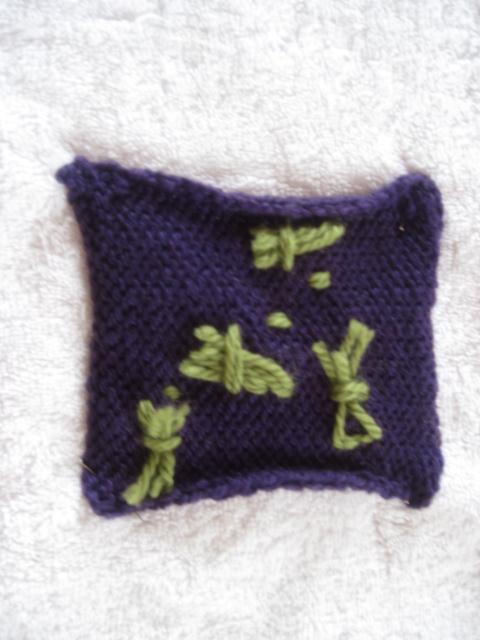
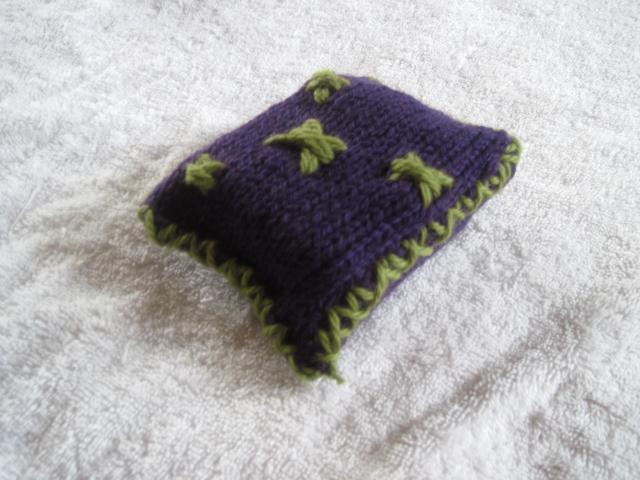
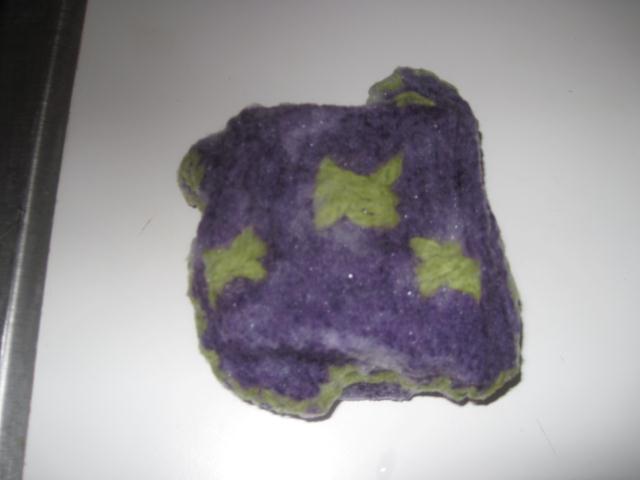
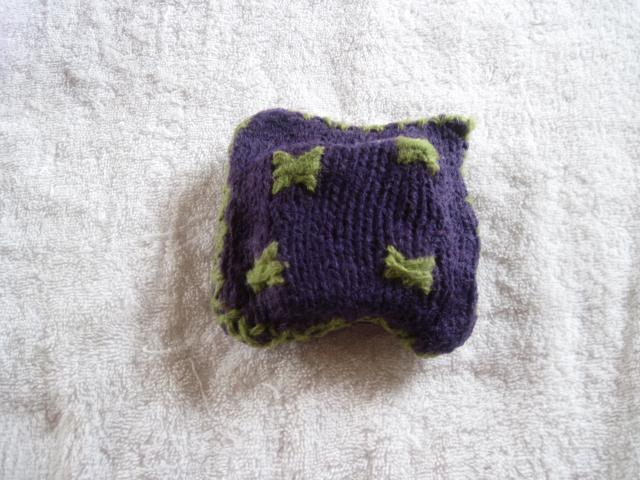
So after felting soap with roving (see: Get Clean While Making Felted Soap 9/27/11 post),  I decided to try some other ways of felting, knitting with wool yarn with yarn designs and needle felting designs.

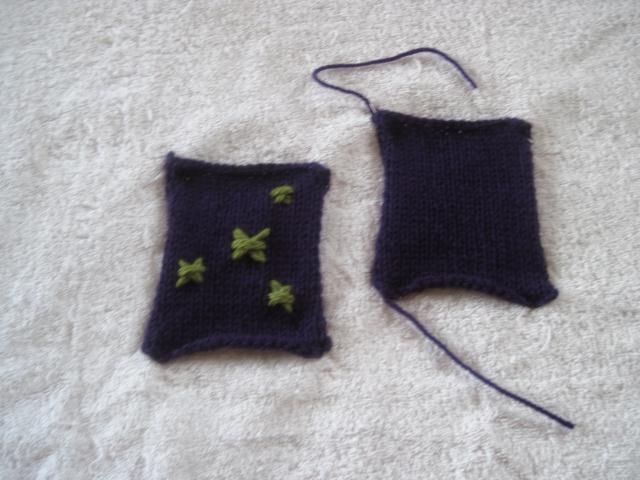
My first try was to knit two squares with wool yarn putting some designs with another color wool yarn on each side.  I used some soap I had made with essential oil and lavender flowers.  I sewed the squares around the soap and then went to the sink.  I decided I would try to felt the knitted squares by hand with the soap inside.  I rubbed and rubbed and the squares did not felt very well, but A LOT of suds formed.  After about 20 minutes – I decided that maybe this was not going to work the way I thought it would.  I wrapped the soap in a towel to get as much water out as I could, shaped the knitted/felted squares around the soap and let dry for several days – turning morning and night.  I decided this is not a way to felt soap. I decided to put the soap in our shower for us to use and after many showers and baths where Stella leaves the soap in the water, squishing the soap through – it is now felting.  Once the soap is done in this one – I will cut open and re-use with another bar.


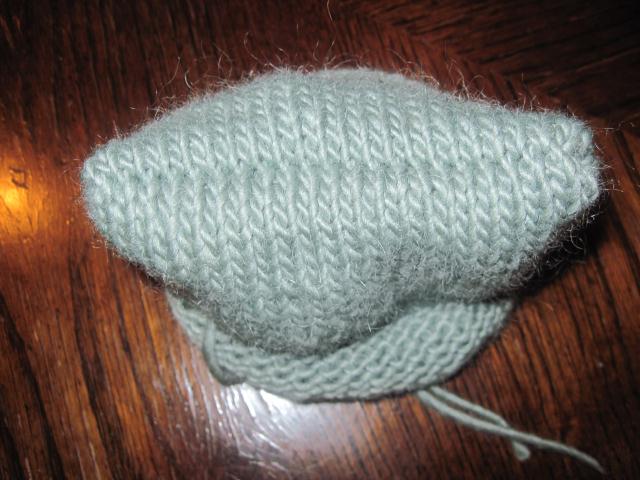
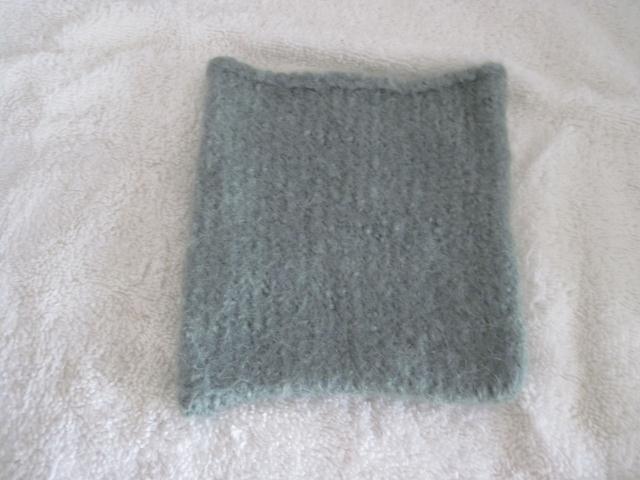
Back to the drawing board I went to think of how else to do felted soap by knitting and come up with a pattern.  After a couple of days the idea came to me – knit a pocket, felt it, put the soap in, close it with a drawstring and do some needle felting on it.  I decided that with using a drawstring it would be easy to re-load with new soap, instead of cutting it open and re-sewing.

Materials

Wool yarn – that can be felted
Double pointed needles
Darning needle
Wool roving
Stencils (optional)
Needle for felting

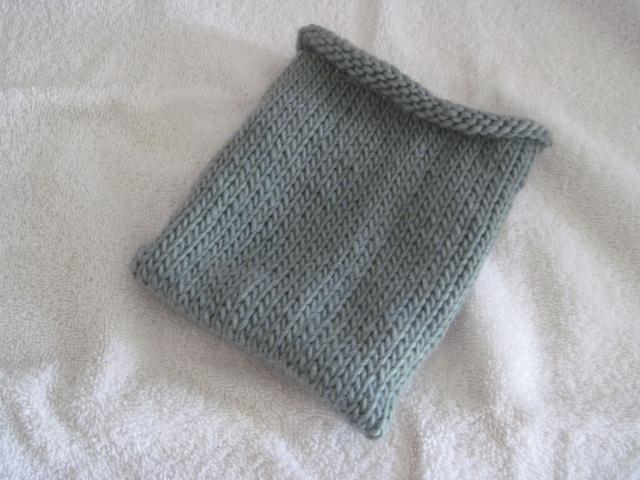
I used #8 size, double pointed needles and cast on an amount of stitches that can be divided by 2 and evenly divided on 3 needles (36 stitches, 12 stitches on 3 needles, 18 stitches on two needles for ending, for example), using the knitting on cast on method.  Depending on the size of your soap and yarn/stitch measurement, you will be able to decide how many stitches.  Knit in the round, making sure not to twist the first row.  Remember that this will felt down so make sure there is ample space all the way around the bar of soap, leaving extra space for tying up at the end.

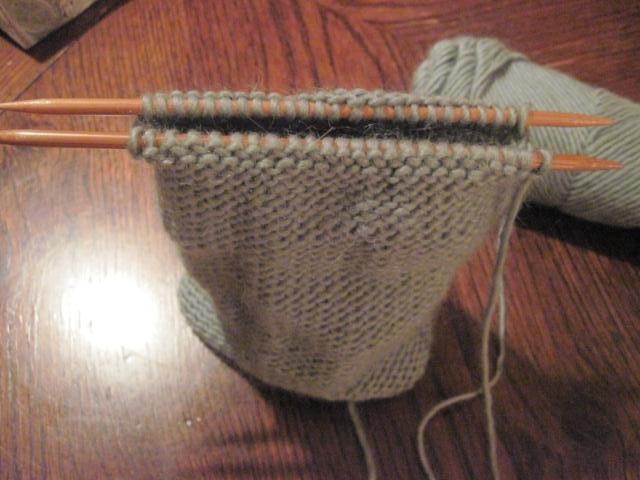
Once you have knitted a tube that will cover the soap, with the extra space, you can test along the way by sticking the bar of soap inside the tube you are ready to seam it up.  The cast on side with be the opening.  You will need to place an even amount of stitches on 2

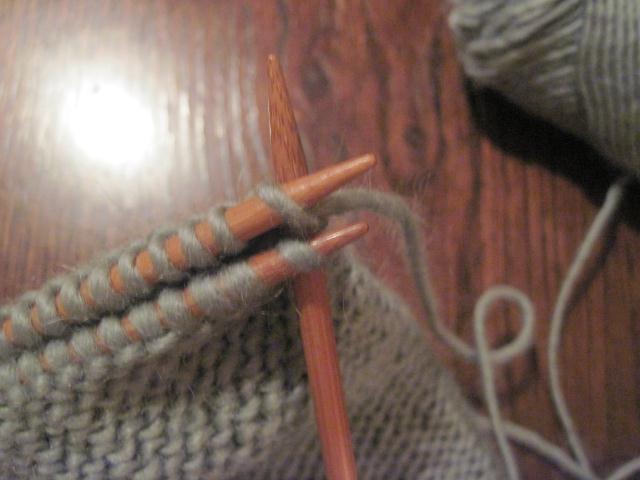
Getting ready to start seam

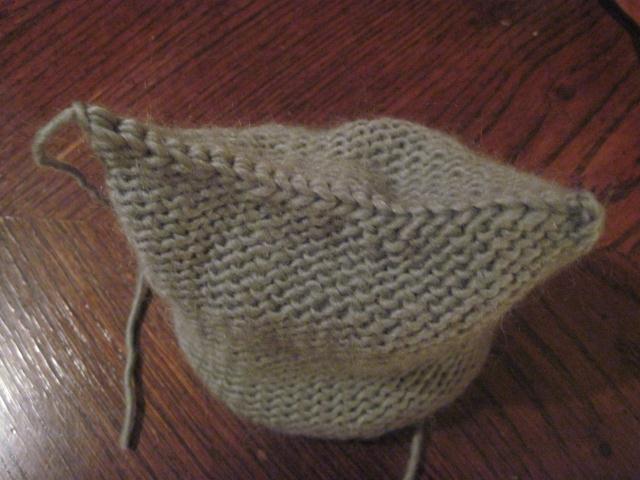
needles (18 stitches each on 2 needles, for example).  Turn the tube inside out and put both needles together, using another knitting needle (same size) knit together the first stitch on each needle.  Knit together the second stitch on each needle point, then slip the first stitch over the second stitch, binding off (not too tightly) and joining the base of the bag at the same time.  Repeat this until all stitches are bound off. Weave in ends.


Starting the seam

Inside Seam

Right side seam


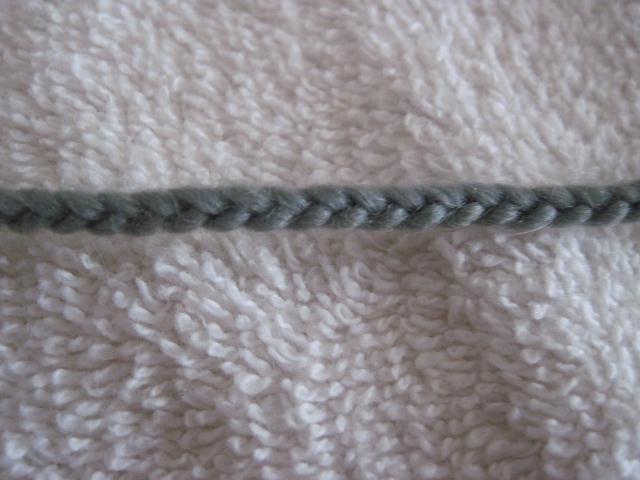
Making the drawstring – cut 3 very long pieces of yarn.  Secure
one end with a knot and braid – take into account that it will shrink when felted – so make it extra long.  Knot other end.  The knots will be cut off when sewing into bag at end – so take that into account too when sizing drawstring.

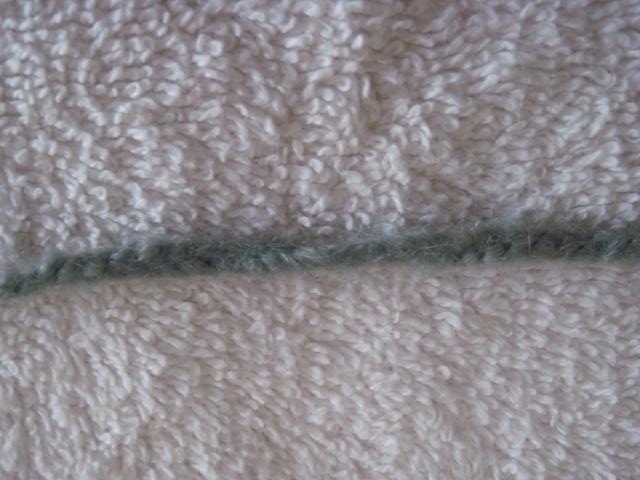
Fill the sink with hot water, as hot as you can take.  Place the completed bag and drawstring in the water.  Add a small amount of dish soap to the bag and start rubbing, making sure it is fully saturated, keep rubbing in all directions – you can rub with your hands or rub the bag against itself.  Keep it wet, checking to make sure that all is felted – check size against soap you will be inserting.  Felt the drawstring the same way. When it’s felted enough, rinse in cold water, roll up in a towel to remove excess water and place the bag on something square to shape it while drying.  It will take a couple of days to dry.

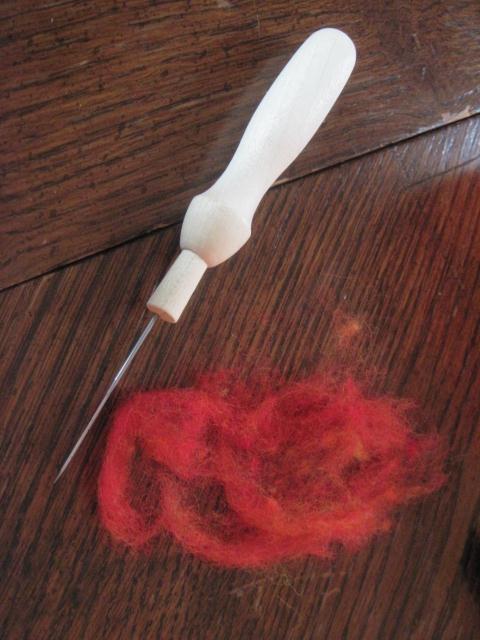
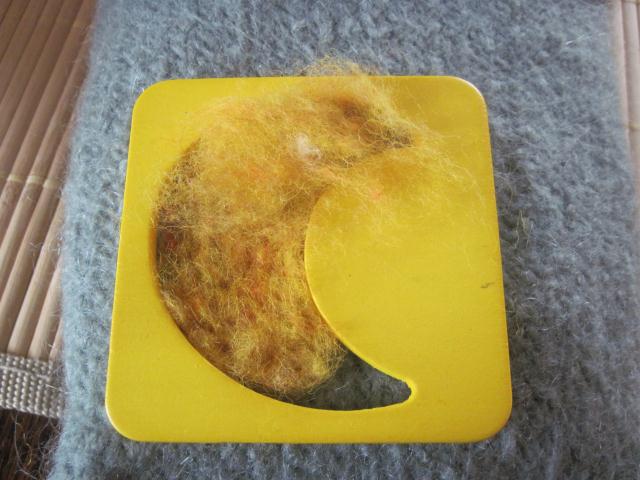
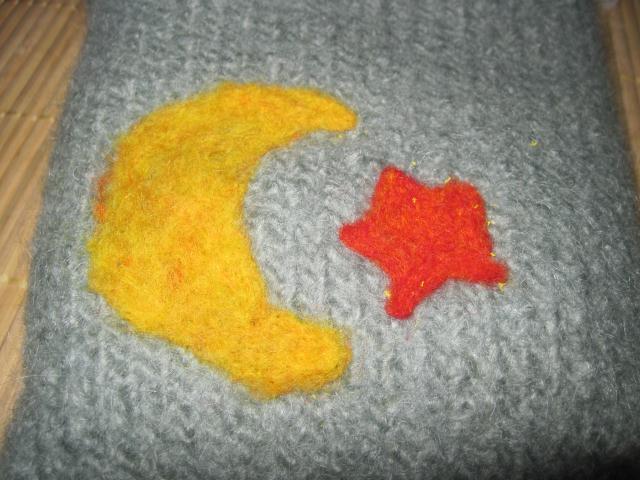
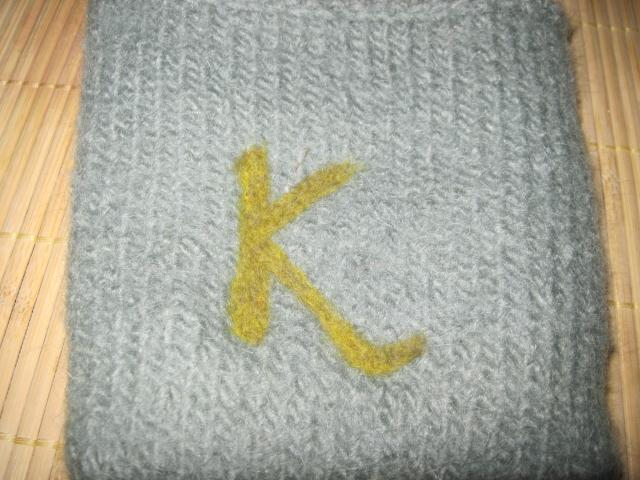
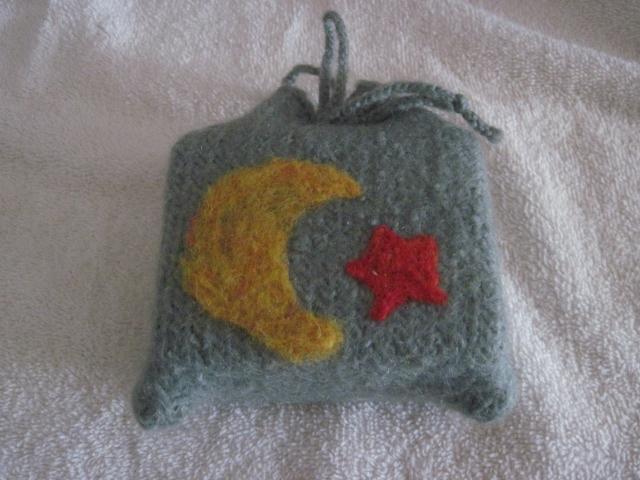
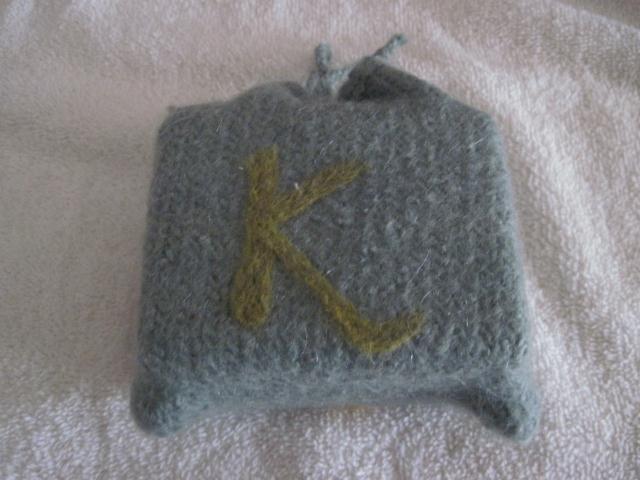
Once the bag is dry you can do some needle felting on it.  You will need a felting needle, they are very sharp – please be extra careful when using.  I decided to use a stencil for the moon and the star.  I decided on what color roving I wanted to use and then taking a small amount at a time, I placed inside the stencil.  You will need to put a felitng pad or you can roll up a place mat and stuff inside the bag, you do not want to felt the sides together. Taking the felting needle, start poking into the roving and bag – the felting needle has little teeth on it and it interlocks the fibers.  Keep poking with the needle until it is felted and secured to your liking.  I also did the other side with a K -since this was a present for my sister – I did the K freehand.


When you are done with the needle felting, put the soap in the bag.  Taking the drawstring, cut off one of knots, thread onto a darning needle and then weave into the top of the bag.  Once you have weaved it in, not to close – this is a drawstring – tie a knot – if the other knot does not look as nice – you can cut that one and re-knot.  Now you are done!


Posted in Crafts | Tagged , , , | Leave a comment

Great Dinner Coming Up! Millet Patties, Acorn Squash and Slow Baked Apples

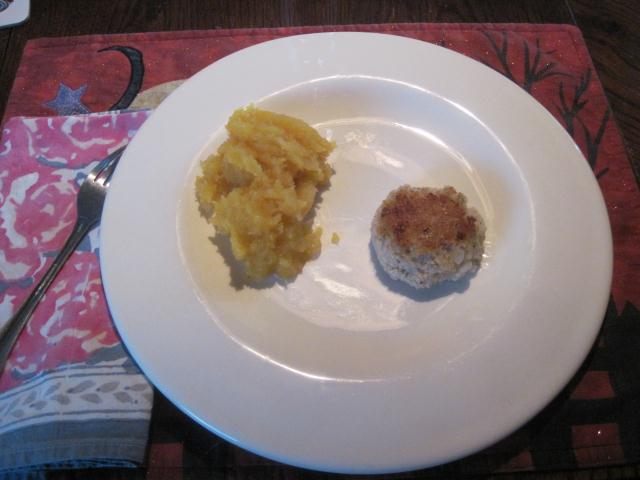
I had intended to try a new soup this week that my neighbors have been raving about, but when the temperature went up to the mid eighties – I decided the soup could wait until a cooler day.  I found an interesting recipe for millet patties and wanted to give it a try and I have wanted to try the slow baked apples in the crock pot for awhile.  Stella convinced me to do the acorn squash just in case she did not like the millet patties – always thinking, she is.

You will cook this meal backwards.  The dessert is started about 3 – 4 hours before you want to eat, the squash about an hour and the millet patties about 45 minutes.  The dessert recipe is the last on this post.

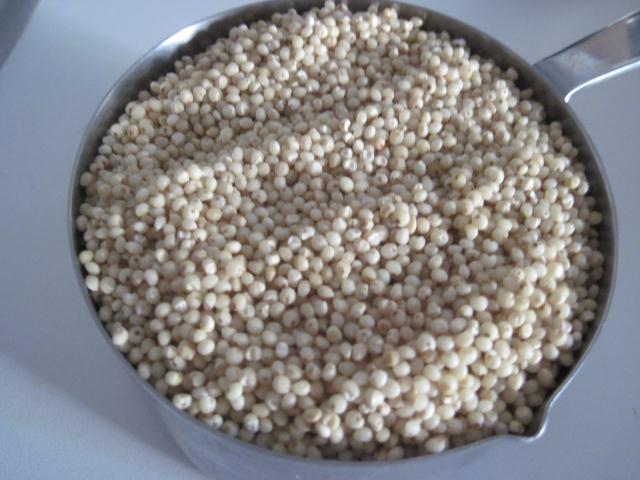
If you are not familiar with millet, here are some basic facts: The protein in millet is very close to that of wheat, it is also rich in B vitamins, especially niacin, B6, folic acid, calcium, iron, potassium, magnesium and zinc.  Millet contains no gluten, so for those of you that need gluten free – here is a good alternative.


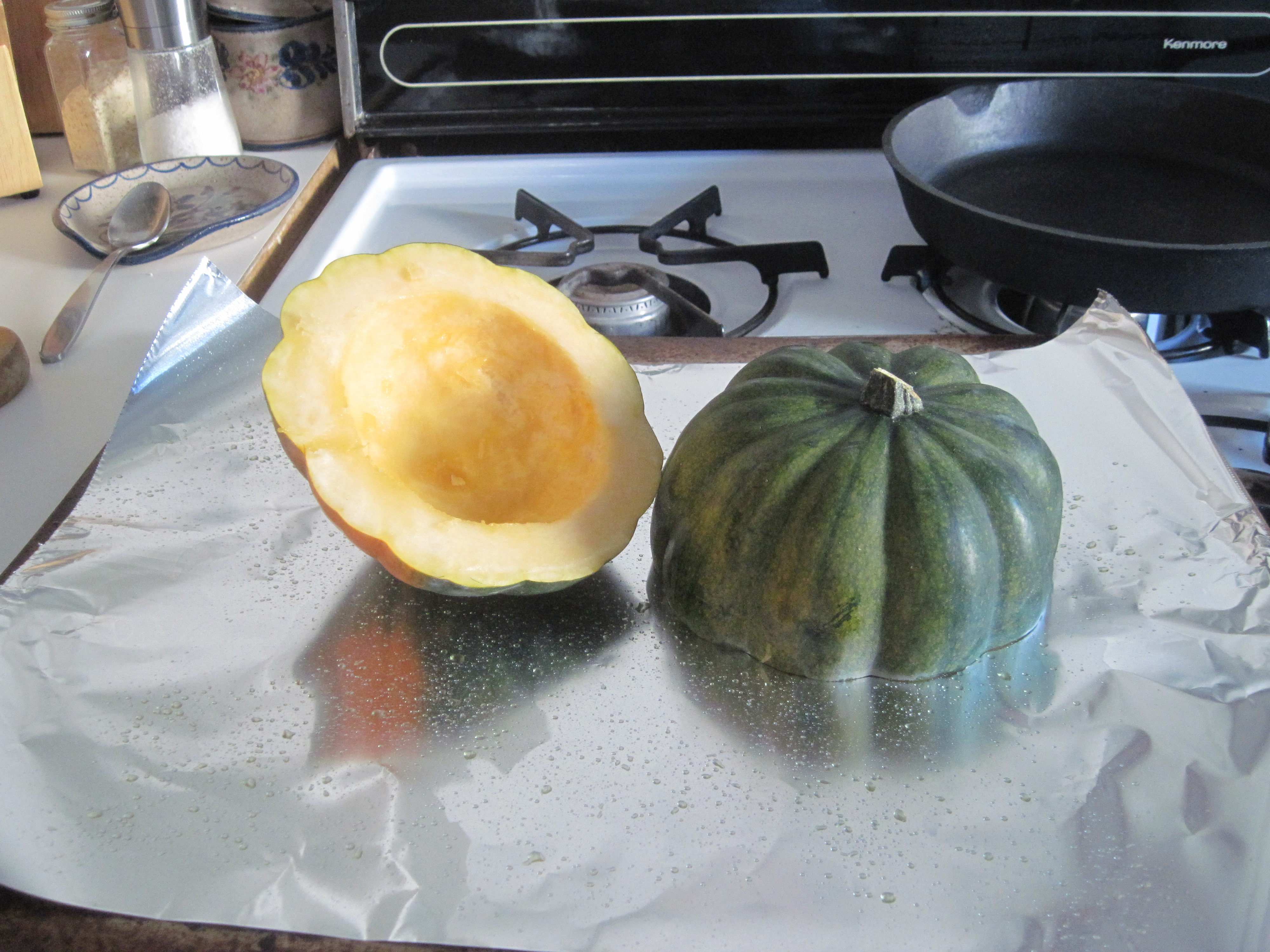
Preparing Acorn Squash

1.  Cut the squash in half and scrape out the stringy flesh and seeds. (this was a nice squash I picked from one of the local farms – so I saved some of the seeds for next year’s garden)

2. Place the squash face down on a tin foil line cookie sheet.  Spray the tin foil with some oil before placing the squash on it.

3. Bake for 30 minutes in a 375 degree oven.  After 30 minutes flip the squash, check to see if done, if not cook for another 20 – 30 minutes – depending on the size of the squash.

4.  The squash is done when a fork goes in easily.  Take out and prepare how you prefer.  I let the squash cool a little, then I take the squash out of the skin and put in a glass bowl, add a little butter and mash – that is all.

Millet Patties (thanks to http://www.everyday-vegetarian-recipes.com/millet-recipe.html)

Ingredients

1 cup millet
2 cups water
1/2 tsp salt
1 tsp dried thyme
2 shallots or 1 small onion, finely chopped (I used the onion)
3/4 cup grated sharp cheddar cheese (I used a NY produced cheddar cheese)
Freshly ground black pepper
Sunflower or peanut oil for frying

1. Finely chopped the onion.

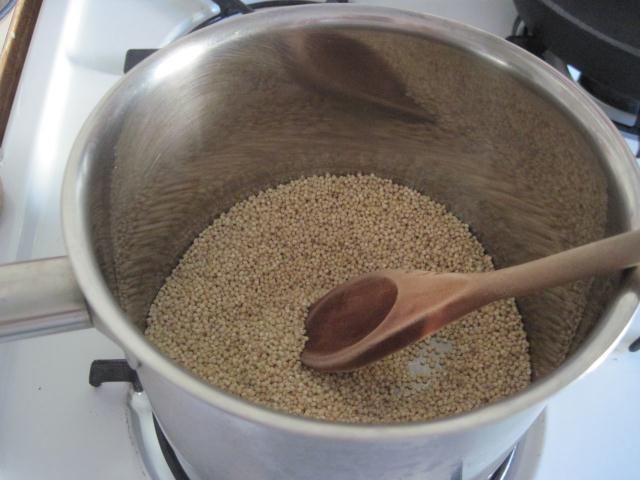
2.  Dry roast the millet grains by placing them in a dry saucepan (make sure the saucepan is big enough to add the other ingredients) over medium heat.  Stir regularly for 3 – 4 minutes, once you start to smell a “popcorn” like aroma and here the millet popping – the millet is roasted.

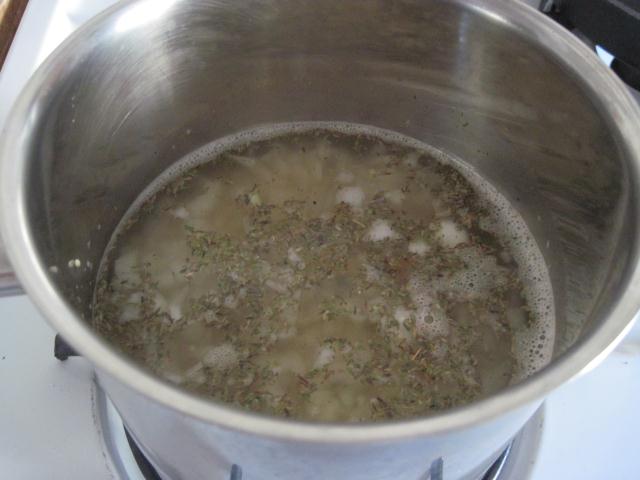
3.  Add the water, salt, thyme and shallots or onions.  When using dry herbs I like to put the amount in the palm of my hand and then crush up the herbs with my fingers – it releases the smell and then through in. Cover and bring to a boil.  Once it is boiling, lower the heat to low and cook for about 15 minutes or until the water is completely absorbed and the millet is light and fluffy.

4.  While the millet is cooking, grate the cheese.

4.  Remove the millet from the heat and season with ground pepper and stir in the cheese while the millet is still warm.  Mix well and allow to cool a little.

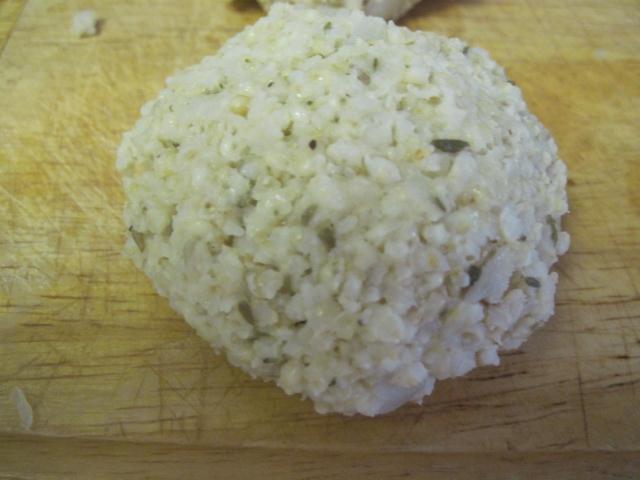
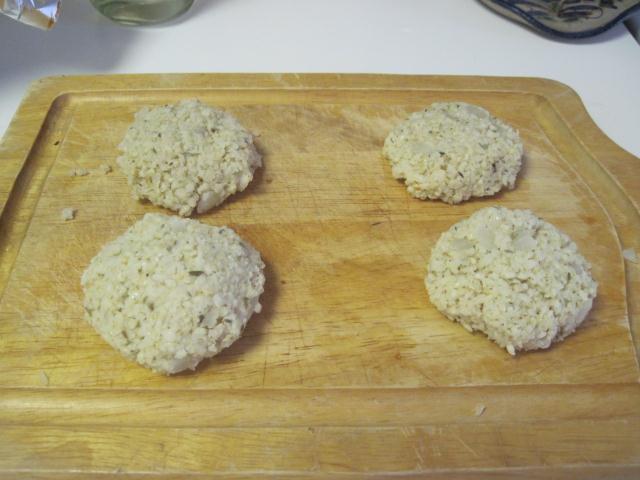
5.  When it is cool enough to handle, take about a golf ball sized scoop of the mixture and shape into little round patties.


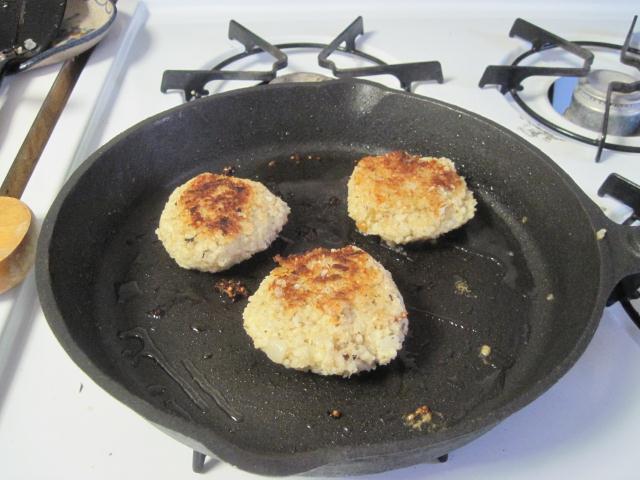
6.  Heat a thin layer of oil in a skillet and set over medium-high heat.  Make sure the oil is hot, then carefully add the patties.  Cook for about 2 minutes on each side or until golden brown.  Serve immediately.  Make about 8 patties

NOTE:  The first batch I did fell apart when I flipped them.  I put the remaining mixture back on the stove and added a little more cheese, mixing to melt the cheese – let it cool and then molded into patties.  I found that if I made them into a ball first and then flattened they held together better.  I loved them, Stella did not – she ate all the acorn squash.

Slow Baked Apples (you will need a crock pot for this recipe)

Ingredients

4 – 6 firm cooking/baking apples, cored
Juice of 1 lemon or lemon juice
1/4 cup firmly packed brown sugar
1 tsp cinnamon ( I use more, because I like cinnamon)
2 Tbl non-hydrogenated margarine (that is what the recipe called for, but I used butter, no margarine in this house!)
1/2 cup apple juice

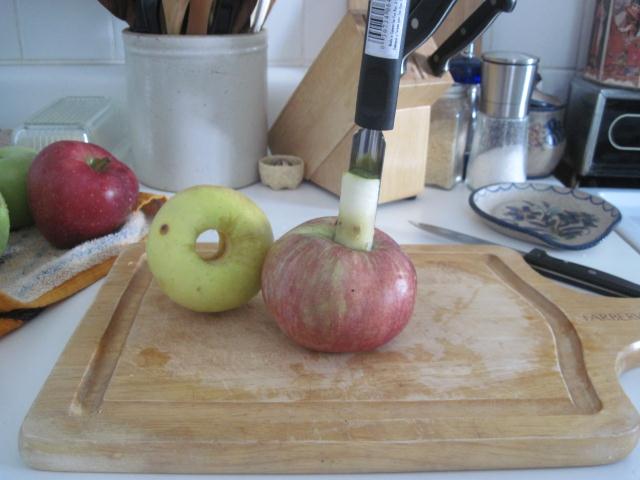
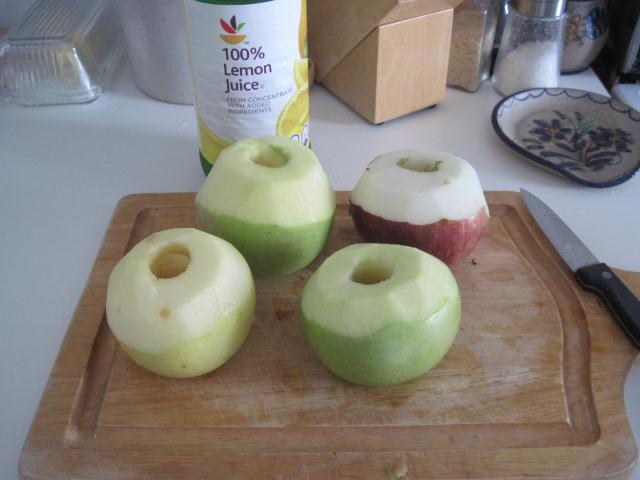
1. Core and peel the apples about 1/3 of the way down from the top.  Rub the exposed part of apple with lemon juice – I put the lemon juice in a small bowl and used my fingers to rub the apples – this is so the apples don’t turn brown.

2. Place the apples in the crock pot.

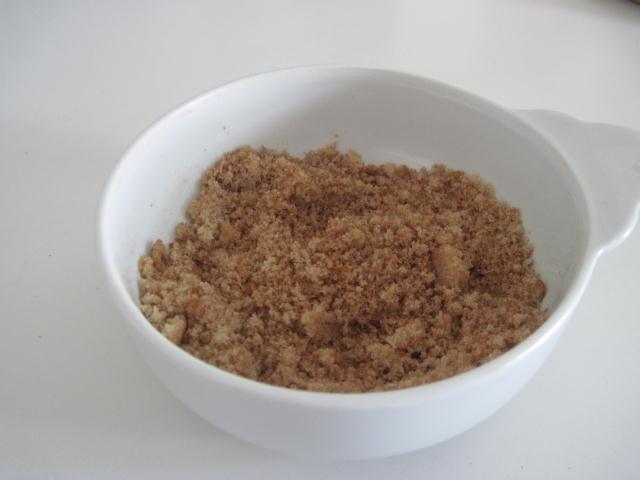
3. Mix the brown sugar and cinnamon in a bowl and then sprinkle over the apples.

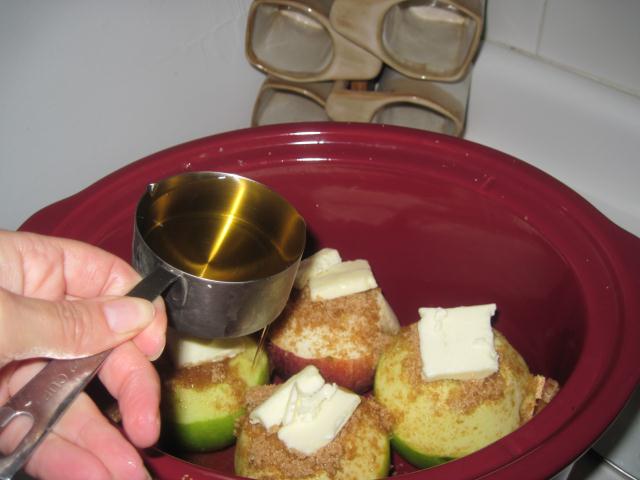
4. Place a pat of butter on each apple.  Pour in the apple juice.

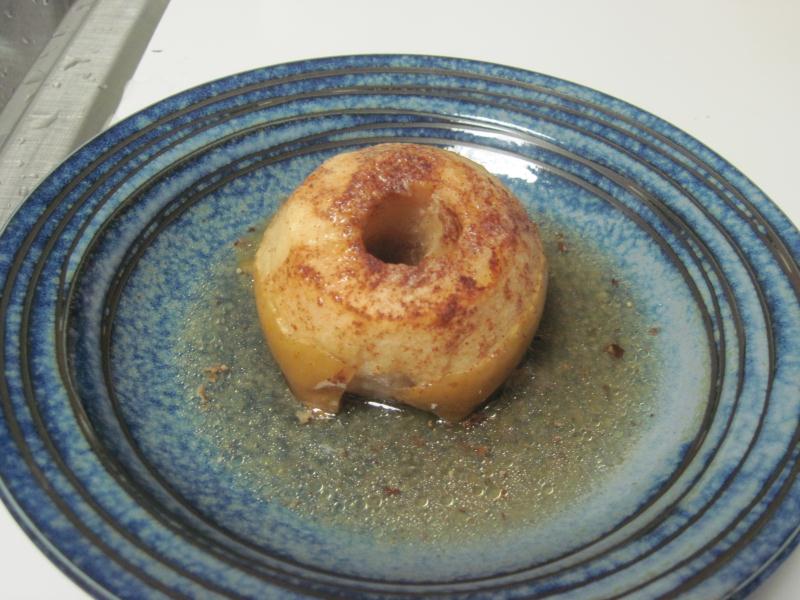
5. Cover and cook on low for 3 – 4 hours, until the apples are tender.  You can serve, hot, room temperature or chilled.

These turned out delicious – I really like the fact that the apples kept the tartness, so they were not too sweet – just the right balance between sweet and tart – of course Stella loved these!


Digiprove sealCopyright secured by Digiprove © 2011
Posted in Recipes | Tagged , , , | Leave a comment

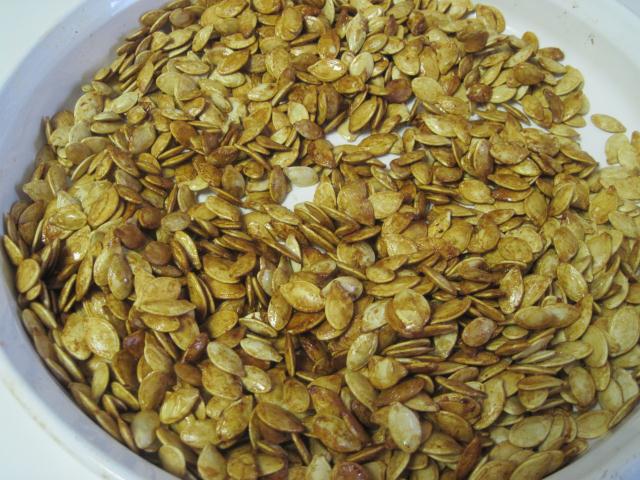
Roasted Pumpkin Seeds, Just Like Popcorn?

After preserving 10 sugar pumpkins I had sooooo many seeds.  I usually do not roast the seeds from our jack-o-lantern, so much work for so little seeds, but I could not, not roast all the seeds I had accumulated.

Drying and Roasting Pumpkin Seeds

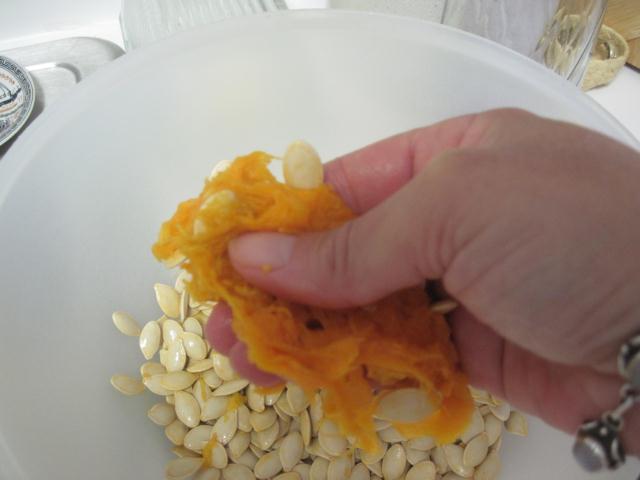
1. After scooping the stringy flesh from the inside of the pumpkin, pull and squeeze the pumpkin seeds into a bowl.


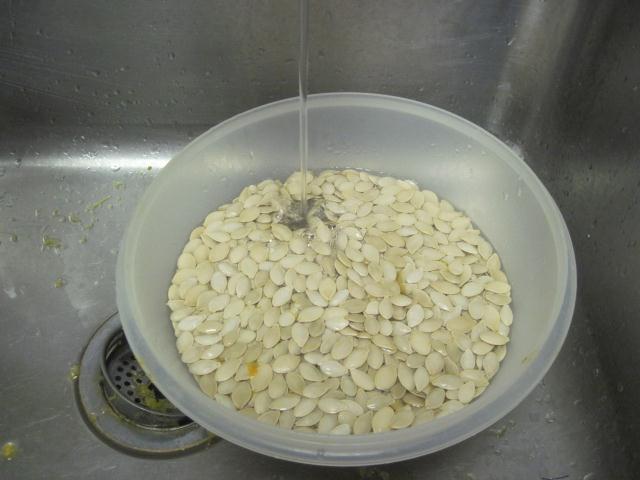
2. Place some of seeds into a bowl and fill with water.  Scrub the “flesh” off the seeds.  I would just scoop seeds up in my hands and rub together.  For each bowl of seeds I did this for about 10 minutes.  Any flesh caught on my hands or floating in the bowl I put on a towel I had laying next to me on the counter.


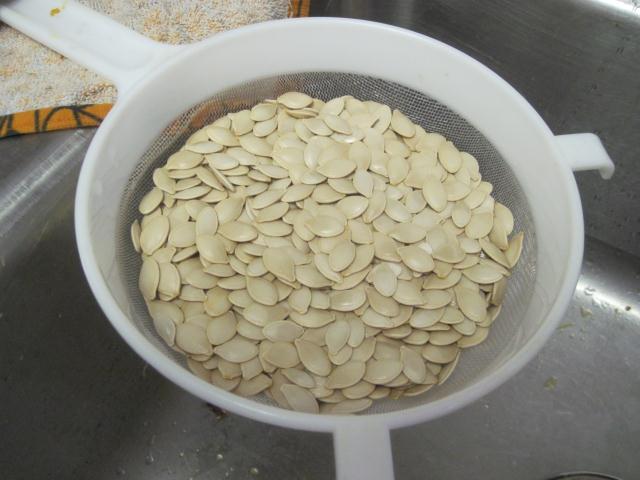
3.  When I felt that the seeds were well washed – I scooped them up in my hand, letting the water run out back into the bowl, pulling anymore “flesh” off the seeds and then placed them in a colander to drain for at least 30 minutes.


4. Usually I do not dry the seeds first before roasting, but I decided to do the extra step this time and I am glad I did – it really did make a difference in the seeds.  You can dry the seeds several ways –

  1.                Leaving out on a paper bag for about a week;
  2.                Roasting them in the oven for several hours;
  3.                In a dehydrator for 1 – 2 hours, and
  4.               A new one that I read about and tried, using a hair dryer.

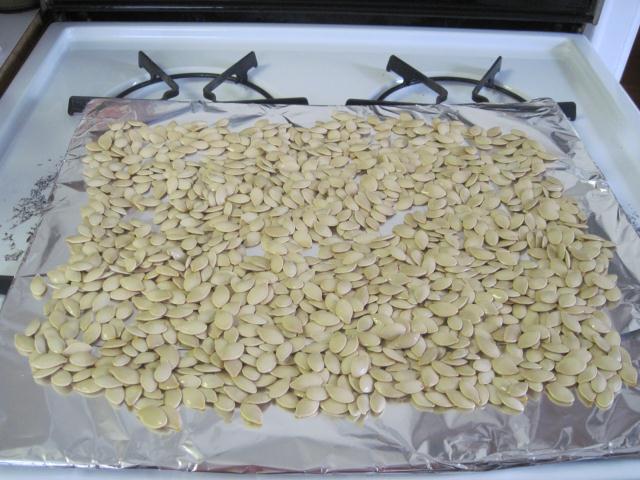
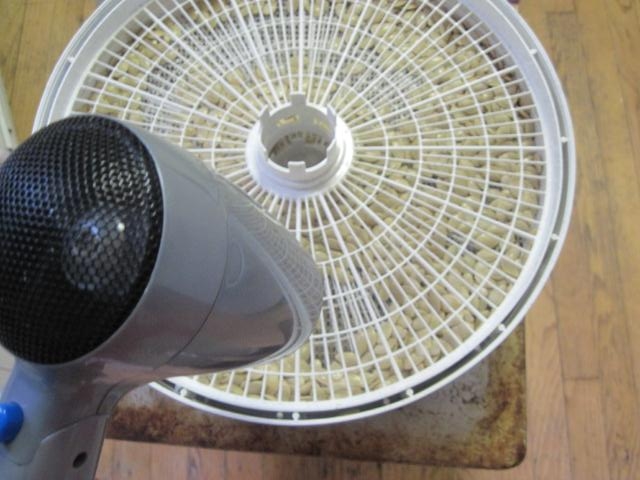
I did some in the oven, placing the seeds on a foiled lined cookie sheet and baking at 170 degrees for several hours, I tossed and turned them during the cooking time.  If you are going to use your dehydrator you will need the “netting” tray insert or else the seeds will fall through – dry for 1 – 2 hours at 115 – 120 degrees.  Now I did read that a fast way to dry the seeds was to use a hair dryer – so I put the seeds on a dehydrator tray and covered with another one and turned the hair dryer on high and dried like I was drying my hair – stopping to toss – it took about 20 minutes.  The way I liked the best was to dry some with the hair dryer, about 10 minutes and then into the oven for about an hour – they seemed the driest. NOTE: Keep the cat out of the kitchen while doing – I was taking a bowl of seeds from the counter to the cookie sheet on the stove and as I stepped back, tripping on the cat – the seeds went flying everywhere!!!  Back to washing and let sit in the colander for those.

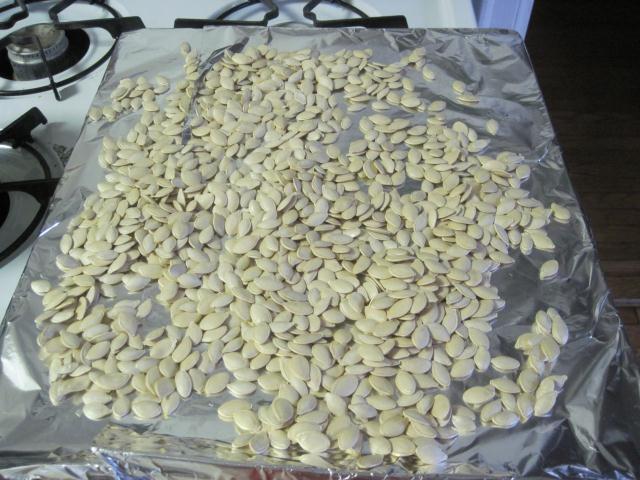
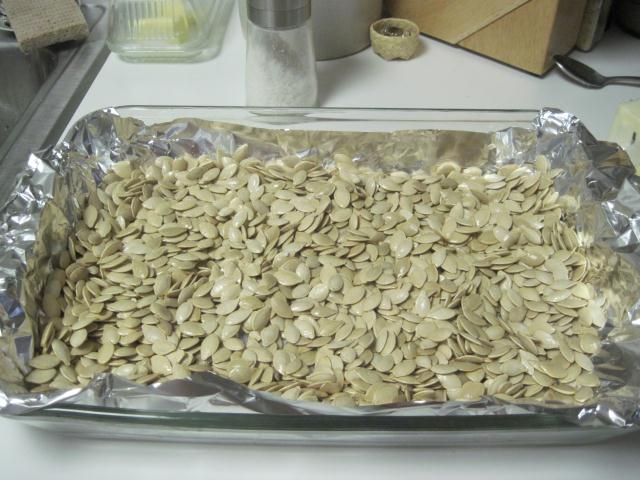
Ready to Dry

Drying with a hair dryer

Oven dried


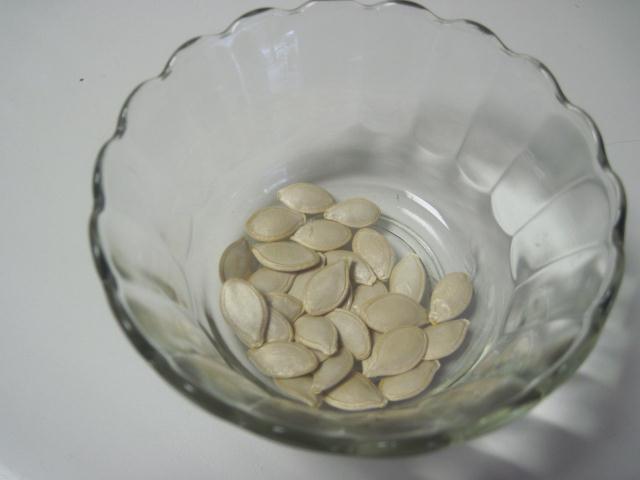
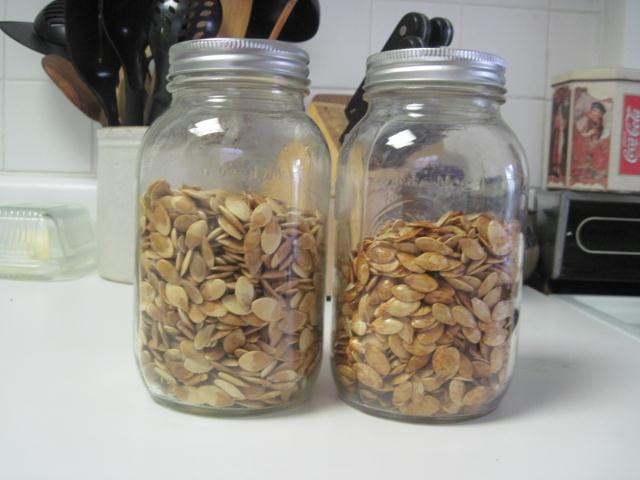
For planting

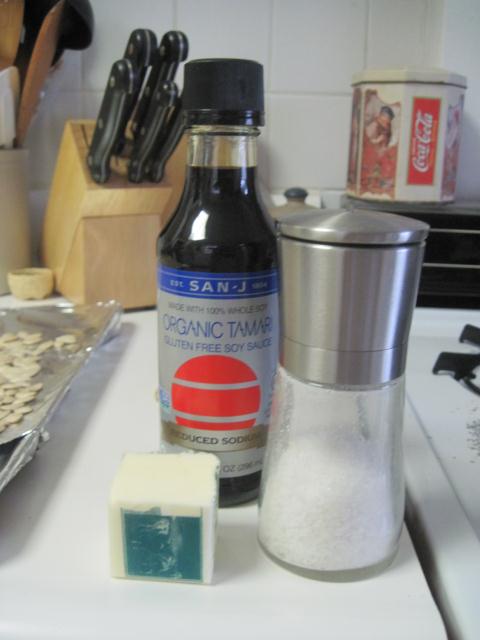
5. Now you are ready to roast.  I decided to roast with 2 different seasonings.  The traditional butter and salt and then when I lived in Colorado there was a great health food store that carried tamari roasted pumpkin seeds – I have never found then anywhere else – so of course that was the other seasoning I did.  At this time if you want to save any of the seeds for planting next year, put the off to the side – make sure they are good and dry and then store for next spring.

Roasting Pumpkin Seeds with Butter and Salt Seasoning

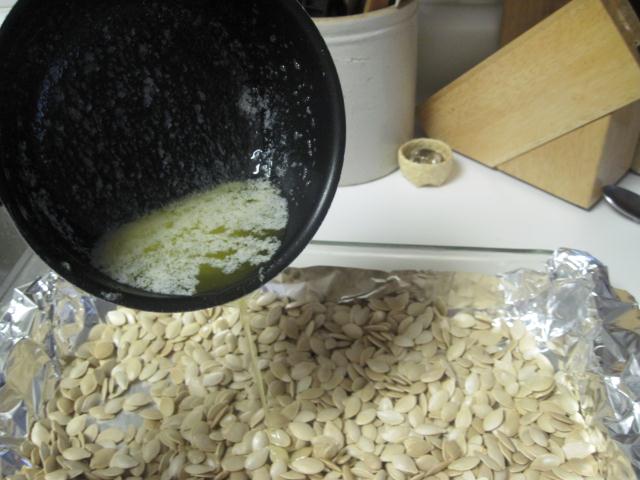
1. Melt 3 – 4 Tbls of butter in a saucepan, adding some sea salt.

2. Line a baking pan with foil and put the pumpkin seeds in – keeping to one level.

3. Drizzle the butter mixture over the pumpkins seeds, toss and add some more salt.

Ready for the oven

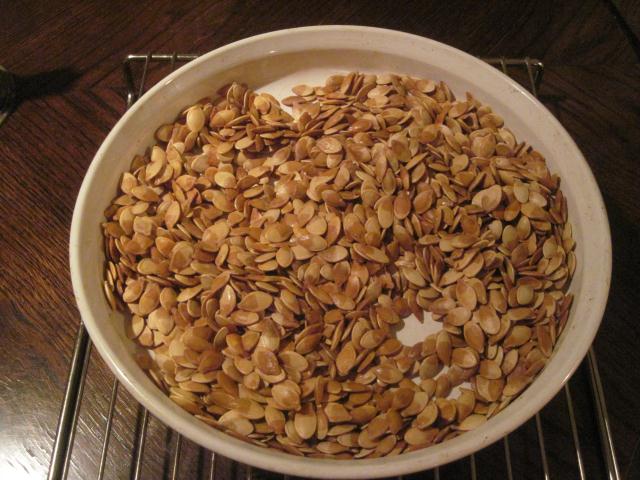
4. Bake in a 275 degree oven for 10 – 30 minutes, depending on your oven.  Every 5 minutes toss the seeds. When they start to turn golden brown, keep a close eye on them, you don’t want them to burn.  When they are all roasted and beautiful take out and let cool – you can sprinkle again with some salt – I did not.

When Stella came home from school, she asked what the smell in the house was – roasted pumpkin seeds, I said.  I am not sure if Stella has ever had pumpkin seeds, she wanted to try them, which she did and loved them.  She refers to them as popcorn – they have been her snack for school all week.  Mateo came over and Stella asked him if he wanted to try my new popcorn – he also loved it.

Roasting Pumpkin Seeds with Tamari Seasoning

1. Melt about 2 -3 Tbls of butter with 2 Tbls of tamari and a little sea salt.

2. Place the pumpkin seeds in a single layer in a baking dish.

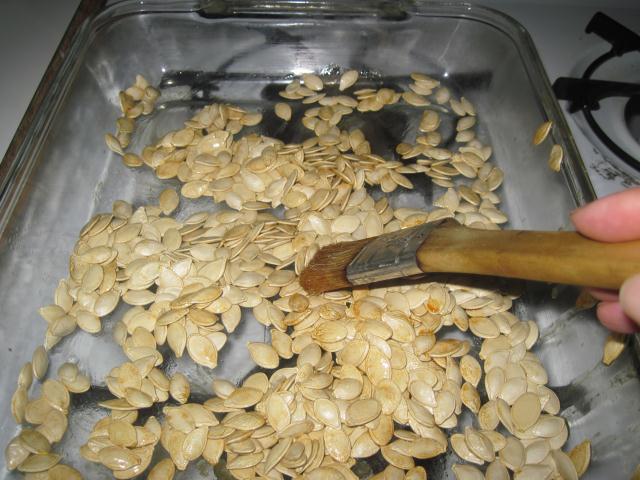
3. Using a basting brush, coat the seeds – make sure they are coated all over.

4.  Bake in a 275 degree oven for 10 – 30 minutes, depending on your oven.  Every 5 minutes toss the seeds. When they start to turn golden brown, keep a close eye on them, you don’t want them to burn.  These took less time to cook – I think it because I basted them instead of drizzling the seasoning on.  Take them out, let cool and then grab a handful and enjoy!  They taste very close to the ones I remember from Colorado.

The seeds are going fast – I may have to hide them from Stella so I can enjoy some!

Digiprove sealCopyright secured by Digiprove © 2011
Posted in Preserving, Recipes | Tagged , | 2 Comments

Easy to Follow Steps to Make Pumpkin Butter

I have never tried making pumpkin butter before, but wanted to try.  I love the internet – you can find anything and everything.  I was surprised to find that you can not can pumpkin butter the same way that you would apple butter. I found this on the University of Georgia’s National Center for Home Food Preservation website http://www.uga.edu/nchfp/tips/fall/pumpkins.html: Home canning is not recommended for pumpkin butter or any mashed or pureed pumpkin or winter squash. In 1989, the USDA’s Extension Service published the Complete Guide to Home Canning , which remains the basis of Extension recommendations today, found in the September 1994 revision. The only directions for canning pumpkin and winter squash are for cubed pulp. In fact, the directions for preparing the product include the statement, “Caution: Do not mash or puree.”

Pumpkin Butter Recipe

Ingredients

4- 5 medium sized sugar pumpkins
2 Tbl cinnamon
1 tsp cloves
1/2 tsp allspice
4 -6 cups sugar

Equipment

Crock pot
Canning jars (1/2 pint size and/or pint size)
Canner
Jar grabber
Small sauce pan
Funnel
Spoon/ladle


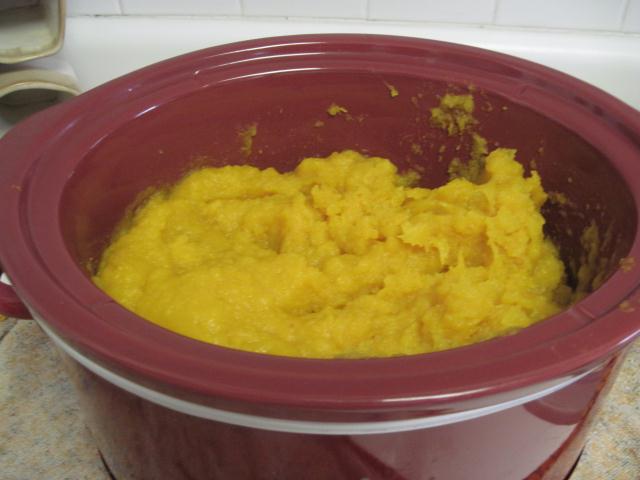
1. Cook and puree 4 – 5 pumpkins (see blog posting from October 5, 2011 – Yummy Orange Goop) – I used 4 pumpkins


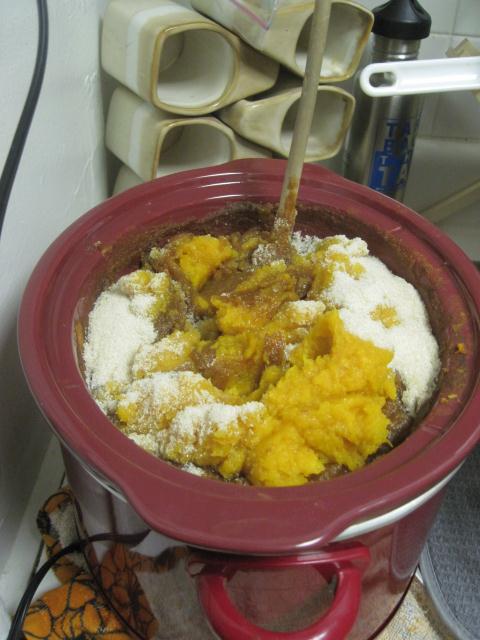
2.  Put the puree from 2 1/2 pumpkins into the crock pot.


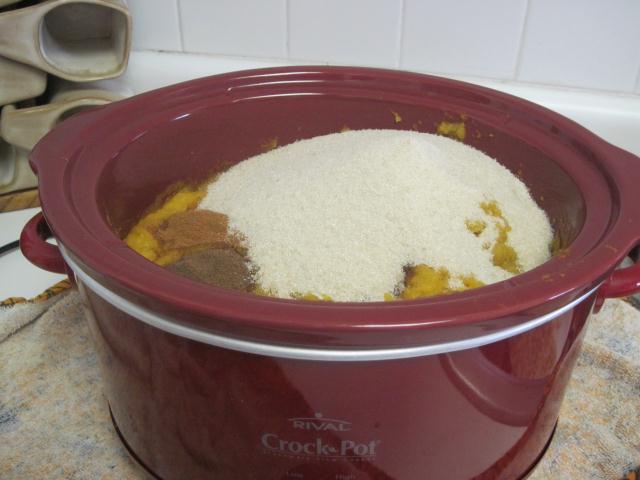
3. Add the spices and 3 – 4 cups of sugar (I used 3 cups) – stir well.


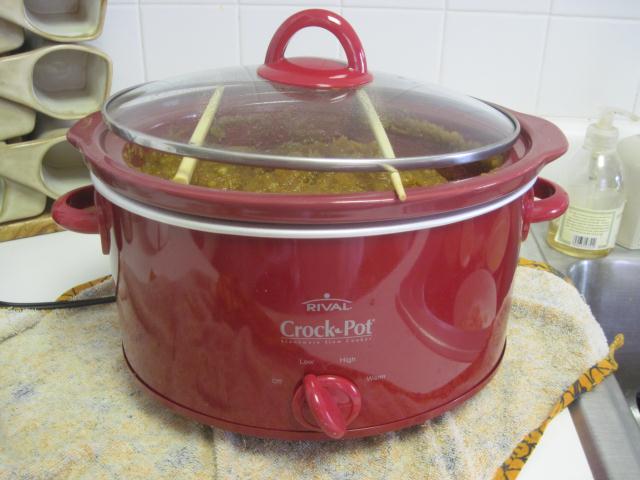
4. Place a towel under the crock pot to catch the splatters. Turn on low or medium and cook for 6 – 8 hours or overnight. Do not seal completely.

NOTE: I left mine on low overnight and it did burn and I lost about a pint of butter – it was almost impossible to clean the crock pot.  If it does burn take out the non-burned butter, place in another bowl clean out the crock pot and then put the butter back in and continue cooking.  I would recommend doing this during the day, so you can stir and watch.  I have never had anything burn in my crock pot – this was a first.

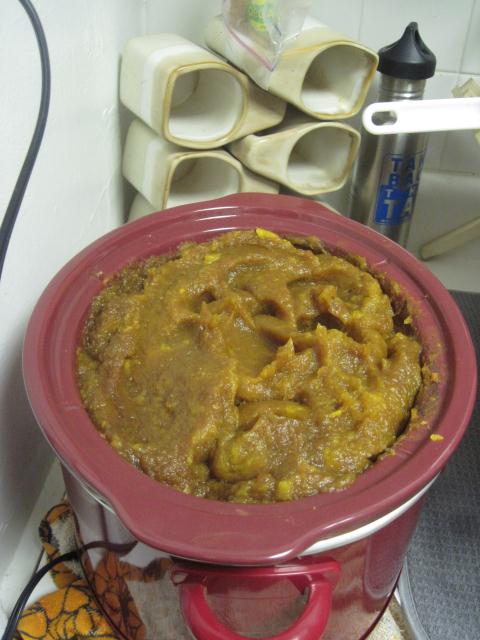
5. Once it has cooked down to about 1/2 of what you originally put in, put the puree from the other 1 1/2 pumpkins (this filled mine to really full).  Add another 1 – 2 cups of sugar (I added 1 more cup), stir well to mix it all together.  Allow to cook on low for another couple of hours – so the flavors mix throughout.


6.  Wash your canning jars and place the canning jars in the your water bath canner.  Bring the water to a boil and turn off – this is to sterilize the bottle, but if you have a dishwasher you can do the washing and sterilizing in one run through.

7.  When the butter has cooked, place the jar lids into a small saucepan, cover and allow the water to boil – turn off and leave the lids in there.

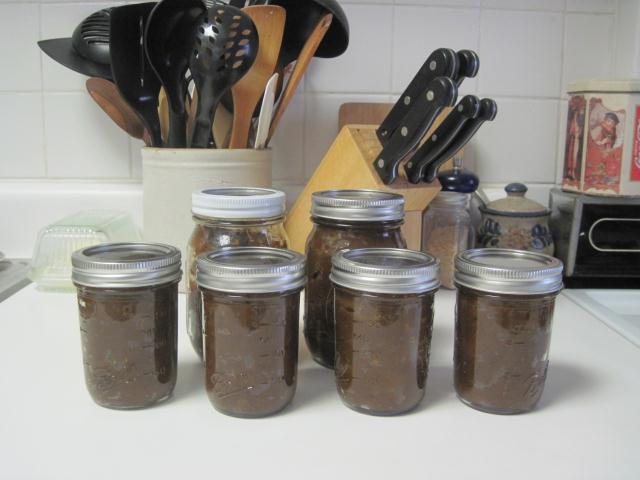
8. Place your jars on a dishtowel on your counter, using a ladle and funnel fill the jars to 1/4 of top.  My butter was so thick that I had to spoon it in! If yours becomes to thick you can add some apple juice and blend in – I did not have any apple juice on hand, wish I did. Wipe the tops of the jars, place the lids on the jars and rings, tighten.

9. Cool the jars and then place in the fridge.  You can not store in your cabinet.

Stella tried some of the pumpkin butter on oatmeal pancakes and loved!  It is good, but I am not sure I would make it again – mainly because of storing in the fridge – not sure how fast we will go through it.

Digiprove sealCopyright secured by Digiprove © 2011

Posted in Preserving, Recipes | Tagged , | Leave a comment

Yummy Orange Goop!

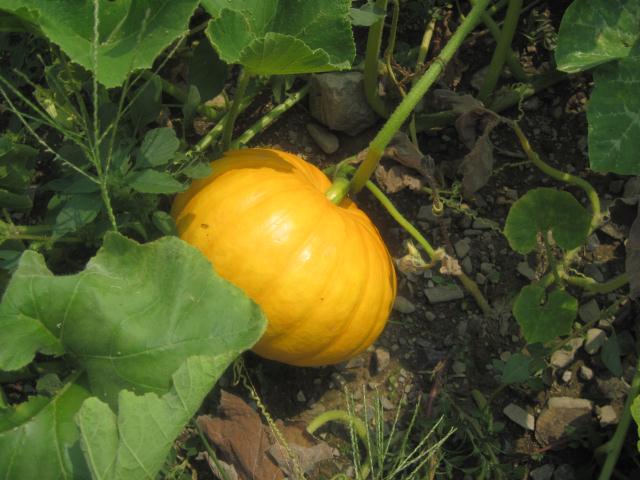
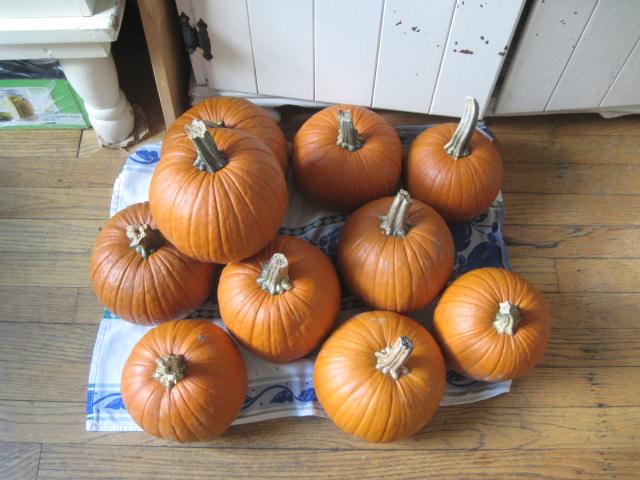
Fall to me means cool days and even cooler evenings and spending more time in the kitchen preparing hearty, comfort meals.  I love squash, pretty much any kind and so does Stella, but I think her favorite is pumpkin, so I was excited this year that I found a farm that grew sugar pumpkins.  Sugar pumpkins are different from the pumpkins that you carve for your jack-o-lantern – they are smaller, a richer orange color and is what is used for pumpkin pies.  The girls picked 11 pumpkins and I ended up with 10, gave 1 away – I was very excited to preserve for use later in the season.  There is one market here that carries them, but for a very short time and they go FAST!

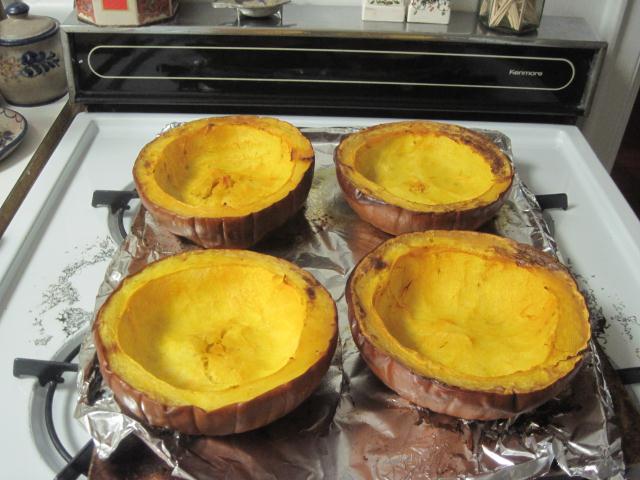
First I had to cook the pumpkins for anything else that I was going to do – so to the kitchen I went.  You can get a good upper arm work out preparing pumpkins.  First thing, wash the pumpkins – if you picked from a farm – usually the store bought have been washed of dirt for you.  Then you will need to take the stems off, I wrapped a towel around the stem and pull in the opposite direction of how it grows.  Not all are that easy to pull off and some I had to cut around the stem and then break off.

I decided to take 6 of the pumpkins and preserve by freezing for later in the fall and winter.

Preserving Pumpkin Puree

1. Wash the pumpkins and break the stems.

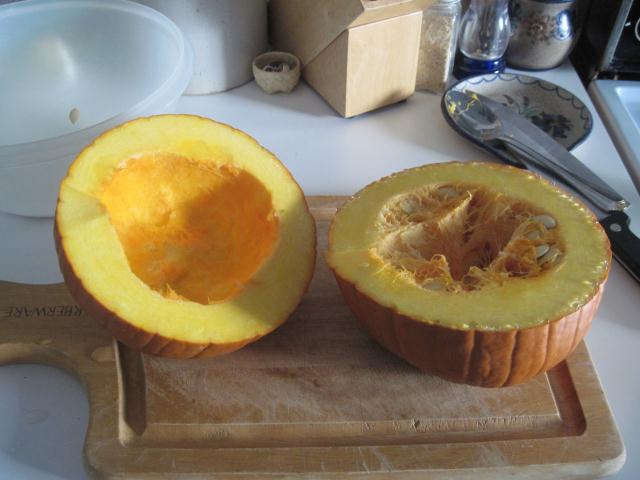
2. Cut the pumpkin in half and scrape out the stringy inside – saving the seeds – you want to use the seeds for roasting.


3. Line a cookie sheet with tin foil, shiny side up and spray with oil – I use a misto filled with olive oil.


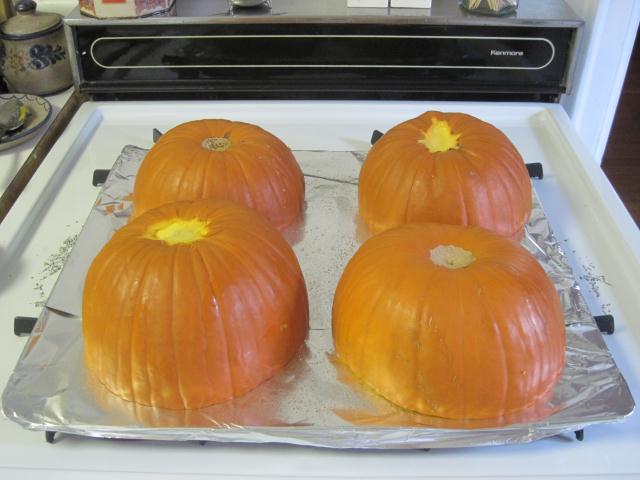
4. With the pumpkins facing down bake in the oven for 30 minutes at 350 – 375 degrees.  After 30 minutes flipped over and continue to cook for another 30 minutes or until a fork goes into the “meat” easily.  You want the “meat” to be very soft.


5. Once the pumpkin is cooked, take out of the oven and let cool enough so that you can handle.


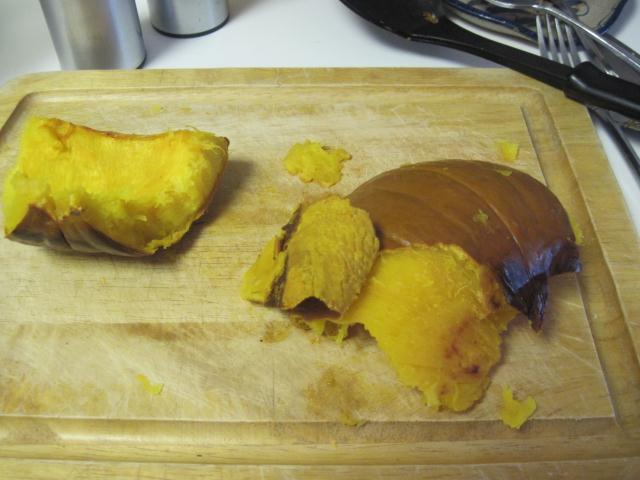
6. Peel the skin off.  If the pumpkin is cooked enough, the skin should easily peel right off.


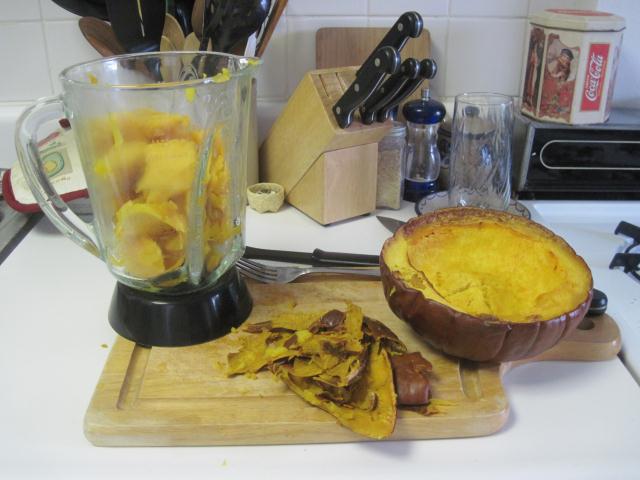
7.  You now need to puree the pumpkin – you can do this with a handheld mixer, food processor or blender.  I find I like to put the pumpkin, usually 1 full pumpkin (2 halves) into a bowl and use a potato masher and then put into a blender to puree further.  This is probably an extra step, but that is how I like to do it and I told you you would get a good upper arm work out – so combining this with cutting the pumpkins – your arms will feel it.


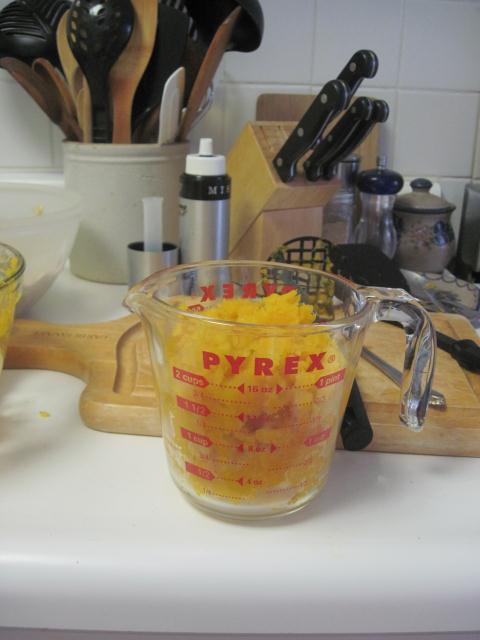
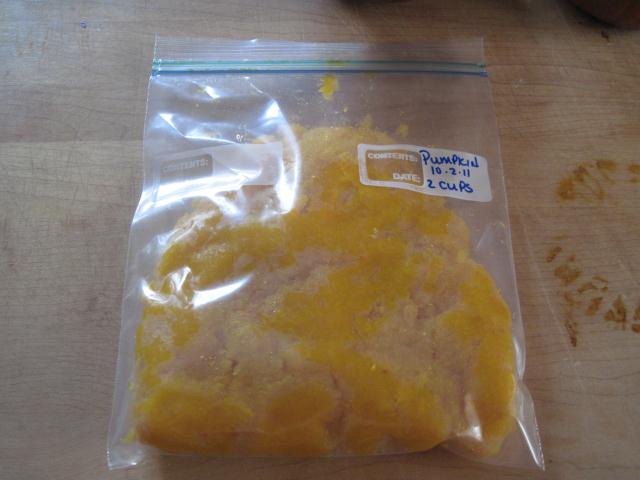
8.  Fill a measuring cup with 2 cups of the puree and then transfer to a freezer bag.  Flatten the puree out, squeeze out as much air as possible and seal the bag.  Place in the freezer.  I usually use about 2 cups at a time, but you can freeze different amounts according to how you are going to use.


When you defrost, place puree in a measuring cup or bowl, once defrosted pour off any water and you are good to go with your recipe or as a side with dinner.

I cooked 6 pumpkins and was able to preserve 20 cups of pumpkin and then we had some with our dinner – Stella inhaled it!  I just added a little butter and brown sugar (very little) – it made a nice addition to the fish we had and it added color to the plate.

Tomorrow – pumpkin butter and Friday – roasting pumpkin seeds (so keep those seeds!).

Digiprove sealCopyright secured by Digiprove © 2011
Posted in Preserving, Recipes | Tagged , , , | 2 Comments

Do You Have a Carbon Monoxide Detector/Alarm?

I started my experiment on October 1 to turn off all electronics and lights starting at 8pm and to only use oil lamps and candles.  I wanted to see if it would make me more productive, get more sleep and maybe cut the electric bill.  In September I purchased several oil lamps off eBay and then I did research on lamp oil.  I decided after reading many sites that I would use kerosene, since it burned brighter and I still wanted to be able to get things done. So I purchased KleanHeat Oil Lamp Fuel, it stated that the smell burned off in about 5 – 10 minutes – I was all set!

Saturday night I was home alone, Stella was at a sleep over and at 8pm – the computer, TV, stereo (they are all on power strips, so they were turned completely off) all went off along with all the lights.  I lit 2 oil lamps and the initial smell was horrible, but it did get better.  After about 30 – 45 minutes I could not take the smell anymore and I had left all the windows downstairs open about 2 inches.  I took the dog for a walk to get some fresh air.  When I came back the smell was still there but not as bad.  I did not go upstairs to bed for another 2 hours and when I did there was no smell.

Sunday night I did the same thing.  I wish someone could have taken a picture – I was sitting at the dining room table with the oil lamps and hand sewing Stella’s quilt.  About an hour went by and my head was killing me, I was also feeling a little sick – the lamps went off.  I opened both the front and back door and opened all the windows further.  I took the dog for a walk, when I came back the smell was just a strong.  I went upstairs to get into bed and read – the smell was horrible upstairs, worse than down. I put a window fan in my room, Stella’s room and the hallway and turned them to suck the air out – I knew they were working because I smell the cedar from the attic.  I got into bed and started reading – the headache got worse, then I thought – did I fill the house with carbon monoxide – I ran into Stella’s room and put my finger under her nose – she was still breathing!  I then went downstairs, turned the computer on and looked up carbon monoxide poisoning – yes I had some of the symptoms – but I did not know if it was carbon monoxide related or just from the smell because I do not have a carbon monoxide detector.  Now I was panicking!  I needed to get fresh air into the house if it was carbon monoxide.  Bernie, the dog was just laying on the floor and I could not get him to move – OMG!!!  What had I done!  What about crawlie – the crayfish – he was ok.  All the windows now open, the fans going – what was I going to do – should we go to my neighbors and sleep on her couch, what about Stella!?

Back upstairs I went – I woke Stella up – she said she was dizzy, was it because I woke her from a dead sleep or was it carbon monoxide?  I put her in my bed along with the dog.  I laid next to her with my hand on her stomach so I could make sure she was breathing – I set the alarm for an hour – I did not sleep for that hour – was I crazy, what should I do?  I set the alarm for every hour until it was time for us to get up -then in the morning I thought how stupid – if we died would it take an hour or less – we should have left the house.  All I can say is that I am going out and buying carbon monoxide detectors – one for outside both bedrooms and one downstairs – I don’t ever not want to know again!  If you do not have one. please go out and buy some – carbon monoxide poisoning is serious and deadly – take the precaution!

Digiprove sealCopyright secured by Digiprove © 2011
Posted in Life | Tagged , , | Leave a comment